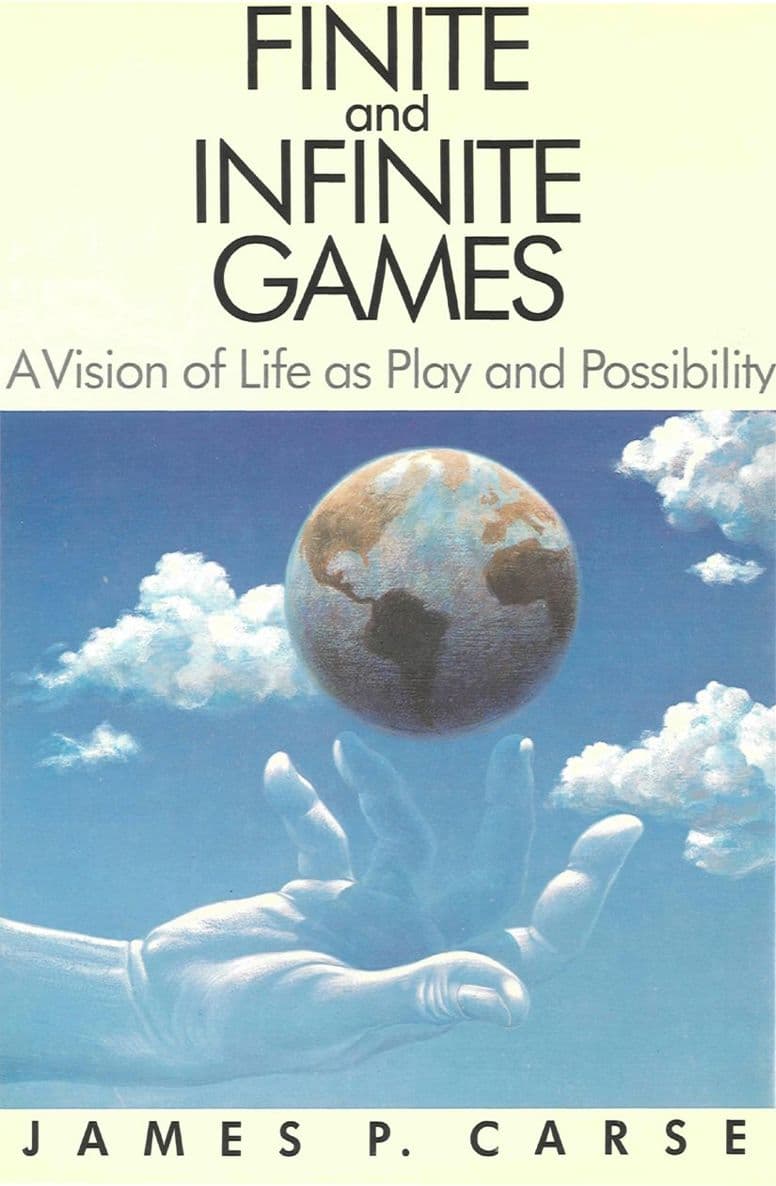
The Game That Learned to Play Itself
Carse published this book in 1986, the year Chernobyl melted and the Challenger broke apart on live television — two finite games ending badly, both watched by audiences who understood, in some inarticulate way, that the rules had failed. His central distinction is elegant and has remained so for forty years: finite games are played to win, infinite games are played to continue playing. Everything else in the book — society versus culture, machinery versus gardens, explanation versus narrative — hangs from that binary like ornaments on a wire. It is a binary that has aged better than it deserves, mostly because the world kept generating examples Carse could not have foreseen. Social media is the obvious one. Twitter, then X, then whatever it becomes next, is a finite game masquerading as an infinite one — users compete for titles (followers, virality, the blue check) within a structure that pretends to be open-ended but is governed by algorithmic boundaries no player agreed to. Carse's framework diagnoses this with unsettling precision. He wrote that finite players play *within* boundaries while infinite players play *with* boundaries, and the platform economy has spent two decades exploiting the confusion between those prepositions. The rise of generative AI lands here too: a machine trained on the entire corpus of human expression, producing language that is, in Carse's terms, pure repetition dressed as origination. He would have recognized the problem immediately. He might not have predicted that billions of people would prefer the repetition.
What Carse could not see — what the Cold War liberal humanist tradition he emerged from structurally prevented him from seeing — is the degree to which infinite games can be weaponized. His framework assumes that the desire to continue play is inherently liberating, that openness and fluidity are goods in themselves. But the infinite game has become the preferred rhetoric of every extractive system that wants to avoid accountability. "Move fast and break things" is an infinite-game slogan. So is "the conversation continues." Authoritarian movements have learned to play infinite games too, shifting rules, refusing fixed endpoints, treating every defeat as a continuation rather than a conclusion. Carse treats finite games as the domain of power and infinite games as the domain of freedom, but the last decade has demonstrated that power is perfectly comfortable with formlessness. The book's blindness to this is not a failure of intelligence; it is a failure of historical position. In 1986, the rigid structures — the Soviet state, the corporate hierarchy, the nuclear standoff — were the obvious enemies. Fluidity looked like resistance. Now fluidity is the water we are drowning in.