The Hoax That Became the Weather
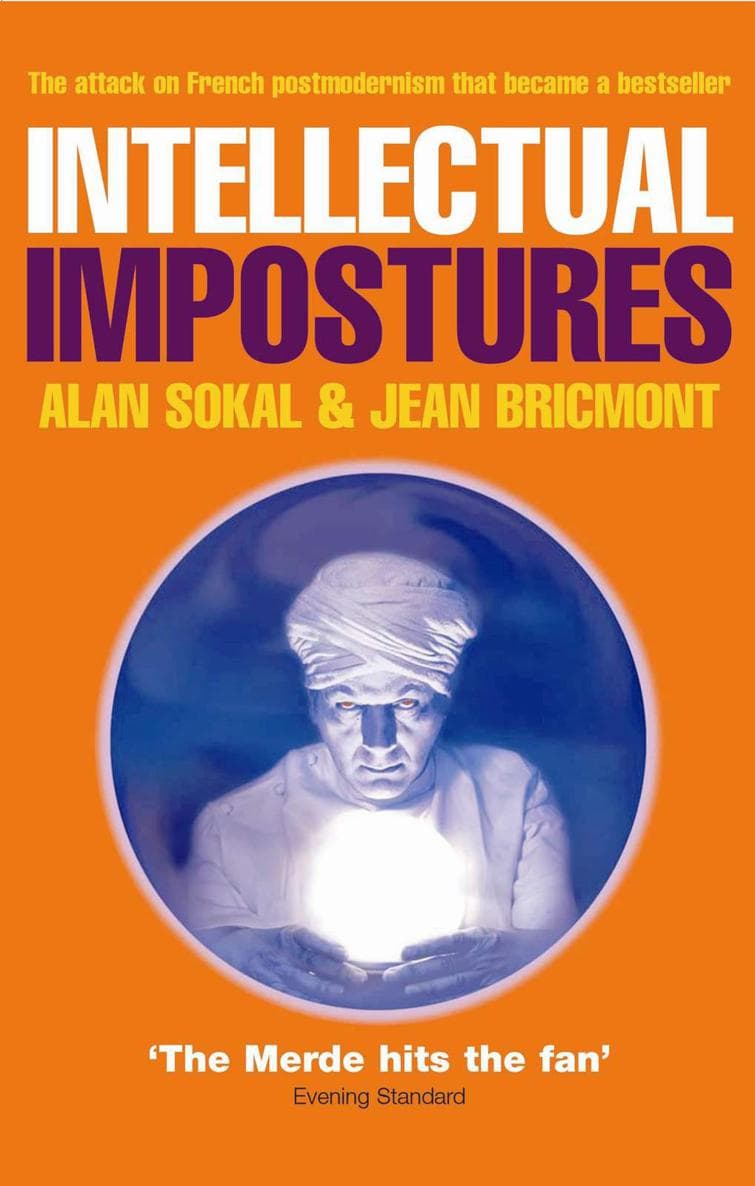
In 1997, Sokal and Bricmont thought they were performing surgery. A precise excision of a specific tumor: the misuse of scientific and mathematical terminology by a handful of prominent French intellectuals — Lacan invoking topology, Kristeva gesturing at set theory, Deleuze name-dropping calculus as though it were cologne. The operation was successful. The patient, however, did not behave as expected. The authors were careful, almost lawyerly, in their disclaimers: this is not an attack on the humanities, not a broadside against the left, not a claim that philosophy must genuflect before physics. They said this repeatedly. Almost no one listened. What people heard was: science is real and your words are not. That mishearing turned out to be more consequential than the book itself.
What Sokal and Bricmont anticipated, with uncomfortable accuracy, was the erosion of shared epistemic standards — the slow, then sudden collapse of the assumption that evidence and argumentation should constrain public discourse. Their critique of epistemic relativism in the academy reads now less like a scholarly intervention and more like a weather report filed decades before the storm. They warned that treating scientific claims as mere social constructions would eventually corrode public trust in science itself. They were right, though the mechanism was not what they imagined. It was not Parisian seminars that dissolved consensus reality; it was algorithmic amplification, political incentive structures, and a pandemic that turned epistemology into a team sport. The relativism they feared escaped the humanities departments, but it did not travel through Derrida. It traveled through YouTube, through Twitter, through the mouth of every populist who learned that "do your own research" is the most effective five-word slogan in the English language. The book diagnosed a real pathology but misidentified the vector.
The blind spot is enormous, and it is the blind spot of the entire rationalist cohort of the 1990s: the assumption that intellectual rigor, once demonstrated, would be persuasive. Sokal and Bricmont believed they were fighting a war of ideas in which the best argument would win. They imagined their opponents were obscurantist professors. They could not imagine a world in which the very tools of clarity they championed — peer review, reproducibility, falsifiability — would be weaponized by bad-faith actors, or in which the "Science Wars" would be rendered quaint by actual wars on science waged by governments and media ecosystems. There is also a conspicuous absence: no consideration of how computational systems might generate text that mimics the very vacuity they mocked. Large language models can now produce Deleuze-flavored nonsense, or Sokal-flavored debunking, with equal fluency and equal indifference to meaning. The imposture is no longer intellectual. It is industrial.