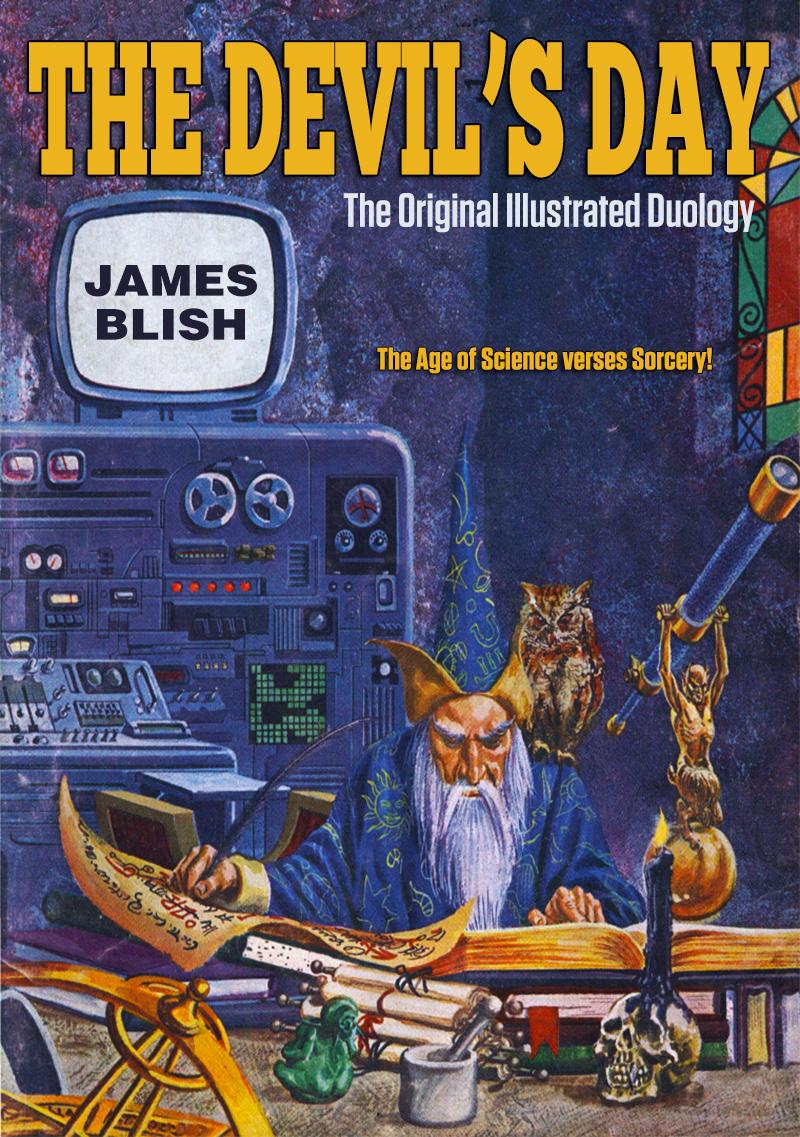
The Consultant, the Sorcerer, and the Itemized Invoice for Armageddon
Baines is ardent about his trade, which is destruction. The sentence sits near the front of the duology like a business card left on a nightstand, and everything that follows is, in a sense, an expense report. A munitions executive whose product line has been made obsolete by nuclear weapons hires a black magician to perform targeted supernatural assassinations, the way a company pivots from hardware to services when the market shifts. The magician, Theron Ware, operates like any specialized contractor: he bills for expenses up front, delivers on a C.O.D. basis, and refuses to waste magic when a phone call or a background check will do. "One thing you must understand," he tells Baines early on, "is that magic is hard work. I don't use it out of laziness." He means this literally. Why summon a great prince and president of Hell to lick stamps? The billable hours wouldn't justify it. The entire first half of *The Devil's Day* runs on this logic — demonology as consultancy, Hell as a supply chain — and it generates a kind of pleasure that almost no other novel about the occult has managed: the pleasure of watching competence applied to abomination with complete professional calm.
What this book understood about 1970, and what lands with full force in 2026, is that the apocalypse would be outsourced. Baines does not want to end the world. He wants to commission forty-eight individual acts of demonic destruction as a kind of artisanal alternative to nuclear war — "not a series of mass obliterations under nobody's control, but a whole set of individual actions, each in itself on a comparatively small scale." He talks about it the way a venture capitalist talks about disruption: controlled chaos, each instance interesting in itself, self-limiting in duration. Father Domenico, the white magician sent to observe, protests that no human being could have elaborated anything so monstrous without the direct intervention of Hell. Ware corrects him: "Most dedicated secularists think exactly as he does — only on a somewhat smaller scale." The novel's most disturbing insight is not that evil scales through demonic intervention but that it scales through the habits of mind that make a man good at business. Baines doesn't need to be possessed. He needs a procurement process. The military memorandum issued later — classifying actual demons as "enemy troops equipped with individual body armor" decorated "in accordance with ancient Oriental custom" — is the same institutional reflex. If the thing can be described in the vocabulary of logistics, it can be managed. And if it can be managed, nobody has to reckon with what it is.