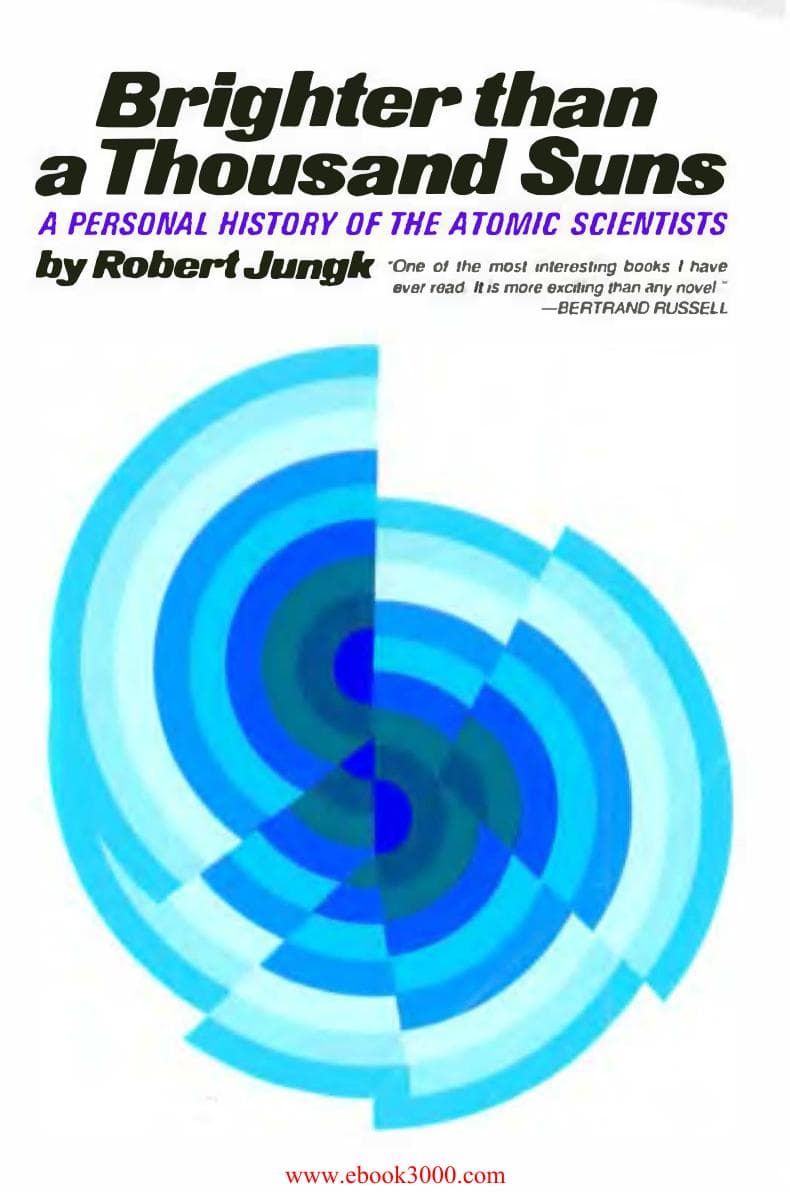
The Conscience That Arrived Too Late
Robert Jungk published this book eleven years after Hiroshima, which means he was writing from inside the blast radius of his own subject. The rubble was still warm. What he produced is not quite history and not quite journalism but something closer to a moral autopsy — an attempt to determine, while the body was still on the table, exactly when the patient died. The patient, in this case, was the idea that pure science could remain pure. Jungk traces the arc from Rutherford's gleeful atom-smashing in the early 1920s through the international physics community's golden age of open collaboration, into the wartime compression of Los Alamos, and out the other side into loyalty oaths, surveillance, and the spiritual ruin of J. Robert Oppenheimer. The structure is biographical and episodic, built from interviews and unpublished documents, and it carries the unmistakable energy of a writer who believes he is recording something that must not be forgotten before it is too late. He was right about that, at least.
What Jungk anticipated with uncomfortable accuracy is the permanent entanglement of scientific research with state security apparatus. His chapters on the post-war loyalty purges, the FBI's sustained harassment of Oppenheimer, and the chilling effect on open scientific discourse read less like 1956 than like a template that has been reused, with minor variations, ever since. The pattern he identified — a state that funds science, then demands ideological compliance from its scientists, then punishes dissent by revoking access rather than issuing formal charges — is recognizable in the treatment of climate scientists, in the politicization of public health research, in the security clearance games still played with researchers who hold inconvenient views. His depiction of Edward Teller as both indispensable and socially radioactive anticipated a type that recurs: the technologist whose utility to power immunizes him from the consequences that destroy his peers. Jungk also grasped, earlier than most, that the arms race was structurally inevitable — that secrecy could not contain knowledge, that monopolies on fissile material were temporary, and that the logic of deterrence would produce an escalation no single actor could stop. The Franck Report, reproduced in his appendices, remains one of the most clear-eyed policy documents of the twentieth century, and Jungk deserves credit for insisting on its importance when it was still largely unknown.
The blind spots are significant and characteristic of their moment. Jungk's framing is almost entirely Western European and American. He acknowledges this in his preamble — Soviet sources were inaccessible — but the result is a book that treats the Soviet bomb as a shock event rather than as the product of an equally complex scientific and political culture. The Soviet physicists are shadows. So are the Japanese dead, who appear primarily as a moral weight on Western consciences rather than as subjects in their own right. Women are almost entirely absent, which is not merely a reflection of the era's physics departments but of Jungk's narrative choices; the contributions of figures like Lise Meitner are acknowledged but never given the structural attention they deserve. More fundamentally, Jungk believed — and the book's entire emotional architecture depends on this belief — that if scientists could organize collectively and speak with moral authority, they could redirect the political trajectory of nuclear weapons. The Pugwash Conferences appear at the book's end as a hopeful coda. Seventy years later, Pugwash still exists, nuclear arsenals have been reduced from their Cold War peaks but remain civilization-ending, and the scientists' movement Jungk championed has been absorbed into a broader arms-control bureaucracy that is, in 2026, visibly fraying. The New START framework is functionally dead. The Bulletin of the Atomic Scientists' Doomsday Clock is closer to midnight than it was when Jungk was writing. His faith in the moral authority of physicists was not wrong, exactly, but it overestimated how long that authority would last once the public grew accustomed to living under the bomb.