The Continuum Tries to Repair Itself
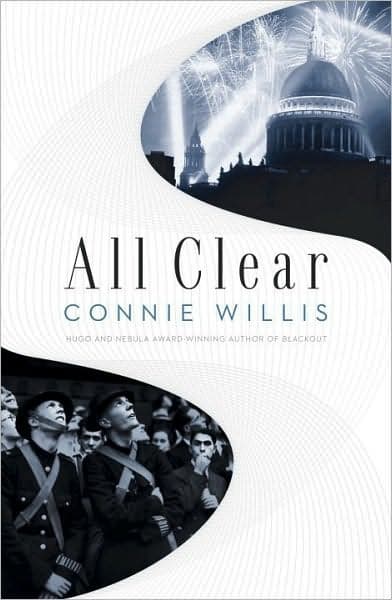
Willis published *All Clear* in 2010, the second half of a single enormous novel about time-traveling Oxford historians stranded in the London Blitz. At the time, it read as a love letter to British resilience, a meditation on the small acts that win wars, and a somewhat maddening exercise in characters failing to share information with each other for eight hundred pages. Sixteen years later, the love letter still lands. The meditation has deepened. The information-sharing problem has become, unexpectedly, the most prescient thing about it.
The book's central anxiety is that tiny interventions—a collision with a stranger, a child pulled from a road, a wrong turn taken—might cascade into catastrophic alterations of the historical timeline. Willis calls this the continuum trying to "repair itself," a self-correcting mechanism that absorbs small disruptions but can be overwhelmed by accumulation. In 2010, this was a clever time-travel conceit. In 2026, after watching algorithmic systems amplify minor inputs into massive social disruptions, after watching misinformation cascade through networks in ways that feel precisely like Willis's "slippage," the metaphor has migrated from science fiction to systems theory. Her characters spend the novel desperately trying to determine whether their actions have broken history or whether history was always going to include them. We now live in a version of that question daily: are we observing the system or have we already altered it beyond recognition? Willis couldn't have anticipated the specific mechanisms—she has no social media, no algorithmic amplification, no deepfakes in her 2060 Oxford—but she understood the underlying topology of the problem. What she missed, and what marks the book as a product of its moment, is any sense that information itself could become weaponized. Her characters struggle to *find* information. They place personal ads in newspapers. They solve crossword puzzles for coded messages. The idea that information might be too abundant, too corrupted, too deliberately falsified to be useful—that particular nightmare was not yet available to her.
The absence is telling in another way. Willis's future Oxford is institutionally stable. The university functions. The time-travel lab has funding and oversight. Bureaucracy is annoying but fundamentally benign. Mr. Dunworthy is a fussy, protective department head, not a man navigating a defunded program or a politically captured institution. This vision of academic continuity now reads as almost pastoral. The book assumes that the primary threat to historical knowledge is physical danger—bombs, fires, lost records—rather than institutional decay, politicized curricula, or the slow erosion of expertise. Willis wrote from inside a world where the humanities still held cultural authority, where knowing the dates of the Blitz carried obvious moral weight. That world has not vanished, but it has contracted. The scenes at the Imperial War Museum in 1995, where Calvin Knight interviews elderly women about their wartime service, now carry an additional freight: we are further from those women, and the infrastructure for listening to them has grown thinner.