The Gods Were Never the Point
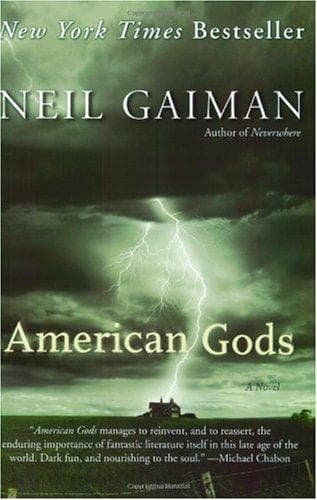
Gaiman published *American Gods* in the summer of 2001, weeks before the event that would permanently rearrange America's relationship with its own mythology. The timing is uncanny but also irrelevant, because the book wasn't about what was coming. It was about what had already arrived: a country so saturated in its own narratives that the narratives had begun to eat each other. Twenty-five years later, the novel reads less like fantasy and more like field notes from a country that still hasn't decided what it worships. The "new gods" — Media, Technical Boy, Mr. World — were sketched as satire in 2001. They are now the operating system. Gaiman imagined the internet as a brash, pimpled adolescent deity. He did not imagine it as the primary venue for radicalization, identity construction, and the literal manufacture of belief. Technical Boy has aged, and not in the direction Gaiman anticipated. The god of the internet is no longer young. He is infrastructure. He is the air.
What the book got right, with startling specificity, is the mechanism: that belief is a resource to be harvested, that attention is worship, and that the competition for it is zero-sum. The war between old gods and new gods is not a metaphor that requires updating. It is the content economy. It is the algorithmic feed deciding which myths get oxygen. Gaiman understood that America doesn't kill its gods — it abandons them, which is worse. Bilquis, the Queen of Sheba reduced to sex work in Los Angeles, is the novel's most brutal image, and it has only sharpened. The scene where she is courted by a man who represents the digital age and then discarded reads now as an almost literal account of how platforms commodify and discard the sacred. What Gaiman couldn't see — and this is the book's most telling blind spot — is that the old gods wouldn't simply fade. Some of them would be *revived* as political instruments. Norse mythology didn't die in America; it was co-opted by white nationalists. Odin didn't need believers. He needed memes. The novel treats the old gods with a melancholy that assumes their irrelevance is permanent. History had other plans.
The immigrant chapters — Salim's humiliation in New York, the African twins on the slave ship, Essie Tregowan's transportation — remain the book's structural backbone and its most enduring achievement. They are also where Gaiman's instincts were sharpest about what America actually is: not a melting pot but a graveyard of portable gods, each one carried across water by someone who had no choice. These interludes do something the main plot sometimes fumbles: they make the metaphysics *material*. Shadow himself is a curiously passive vessel for all this — a man defined more by what happens to him than by what he does — and this passivity, which felt like a narrative weakness in 2001, now reads as a more accurate portrait of the American subject: buffeted, manipulated, asked to choose sides in a war whose terms were set by someone else. The Lakeside chapters, with their small-town warmth concealing ritual sacrifice, have aged into something uncomfortably resonant with the post-2016 discourse about what pleasant communities are willing to overlook.