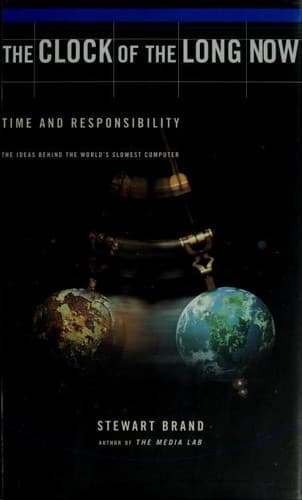
The Clock Was Right About Everything Except the Audience
Stewart Brand built his career on the useful delusion that the right diagram, shown to the right people, could redirect civilization. The Whole Earth Catalog assumed that tools plus access equaled liberation. The Clock of the Long Now assumes that a sufficiently monumental timepiece, buried in a West Texas mountain, could shame us into thinking past the next quarterly earnings call. Published in 1999, at the exact hinge between the millennium bug panic and the dot-com implosion, the book reads now as both prophecy and artifact — a message in a bottle thrown from one shore of the internet to another, arriving on a beach littered with TikTok debris and the smoldering remains of several democracies' attention spans. Brand was right that the acceleration would continue. He was right that digital preservation would become a crisis. He was right that the social sector would grow into a force distinct from government and market. He was even right, in his chapter on burning libraries, that knowledge institutions would remain targets in wartime — Mariupol's libraries were destroyed in 2022, Sarajevo's ghost still walking. What he could not have anticipated is that the most consequential destruction of shared knowledge would not come from bombs or fires but from the slow algorithmic dissolution of consensus reality itself. No one burned the library. The library was simply drowned in noise until no one could find the door.
The book's most durable insight is its layered model of civilizational pace — fashion moving fastest, nature slowest, with commerce, infrastructure, governance, and culture arrayed between them. This framework has aged better than almost anything else from the late nineties futurist shelf. It explains, with uncomfortable clarity, why climate policy lags behind climate science, why infrastructure bills take decades while meme stocks take seconds, why governance operates at a tempo fundamentally mismatched to the crises it faces. Brand borrowed this from ecology and from historians like Fernand Braudel, and it remains the single most useful heuristic for understanding why everything feels simultaneously too fast and too slow. His chapter on "Slow Science" now reads as a quiet elegy; the replication crisis, the collapse of long-term ecological monitoring budgets, the defunding of basic research in favor of applied AI — these are precisely the failures he warned against. The Rothamsted agricultural experiment he admired, running since 1843, still runs. Almost nothing started since his book was published has that kind of institutional patience.