The Hum Before the Network
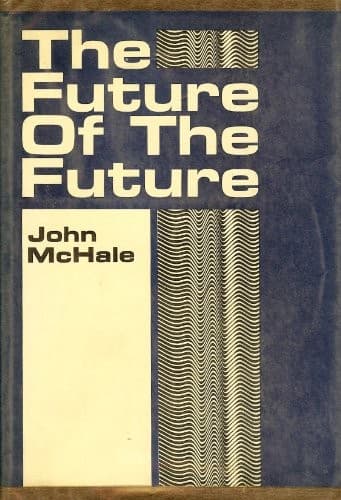
John McHale's *The Future of the Future* arrived in 1969 with the quiet confidence of a systems thinker who believed the diagram could save us. It is a book about prediction that is itself a prediction — one made from the belly of postwar techno-optimism, Buckminster Fuller's geodesic shadow still long across the intellectual landscape, the Apollo program not yet a memory but a present tense. McHale, a pop art theorist turned futurist, assembled an interdisciplinary collage: sociology, cybernetics, political science, ecology, communications theory. The method was the message. He argued that the future was not a destination but a design problem, and that the planet's resources, information flows, and human needs could be mapped, modeled, and managed if only we adopted the right systemic perspective. In 2026, with the planetary dashboard blinking red in several quadrants simultaneously, the book reads less like prophecy and more like an architect's blueprint found in the rubble.
What McHale got right is structural rather than specific. He anticipated the centrality of information as a resource — not just a byproduct of industrial economies but the substrate of future ones. He grasped that global telecommunications would compress geography and reshape political organization. He understood resource distribution as a systems problem, not merely an economic one, and he saw ecological limits as design constraints decades before "sustainability" became a consulting fee. His insistence on interdisciplinary synthesis as the only adequate method for thinking about the future now looks less like academic ambition and more like a survival requirement. The book's emphasis on the acceleration of technological change, on the shortening interval between invention and widespread adoption, maps neatly onto the world that produced the smartphone, CRISPR, and large language models. He saw the curve. He just couldn't see what would ride it.
The blind spots are era-typical but no less instructive for that. McHale's systems optimism assumes a rational actor at the civilizational scale — a global managerial class that would, given sufficient data, make coherent decisions about resource allocation and technological deployment. This is the technocratic faith of the late 1960s in its purest form. He did not foresee that information abundance would produce not consensus but fragmentation, not clarity but noise. The internet is nowhere in the book, of course, but more telling is the absence of any serious reckoning with the possibility that more information could make collective action harder. There is no account of algorithmic manipulation, no sense that the communication systems he celebrated could be weaponized against the very coordination they were supposed to enable. Gender, race, and colonial legacies appear only as problems to be optimized away, not as constitutive forces shaping whose future gets designed and by whom. The Global South exists in these pages primarily as a recipient of systems thinking, not as a source of it.