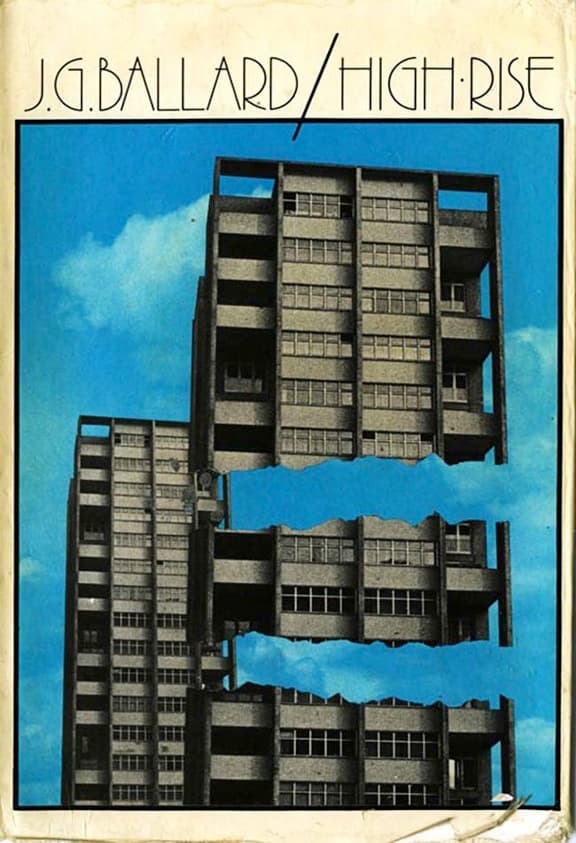
The Vertical Gated Community Eats Itself
Ballard's opening sentence—Laing sitting on his balcony eating a dog—is one of the great cold starts in English fiction, and it has only grown colder. In 1975, *High-Rise* read as satire pitched to the edge of surrealism: a luxury tower block whose professional-class residents devolve into tribal warfare over swimming-pool access and elevator priority. Fifty-one years later, it reads less like satire and more like a feasibility study. The building Ballard describes—self-contained, amenity-rich, designed so that residents need never leave—is not a provocation anymore. It is a product listing. The "vertical city" with its internal supermarket, gym, school, and liquor store is the template for dozens of supertall residential developments in Dubai, London, Manhattan, and Shenzhen. Ballard got the architecture right, and he got the psychology right: the way convenience curdles into isolation, the way shared luxury generates not solidarity but status anxiety. What he could not have foreseen is that the residents would not need to physically barricade the stairwells. Algorithmic feeds, delivery apps, and keycard-gated elevator banks accomplish the same segregation without anyone having to drag a refrigerator across a corridor. The violence in 2026 is quieter. It is measured in eviction notices and HOA fines, not broken bottles. But the topology is identical.
What dates the novel is its sociology, not its architecture. Ballard's high-rise is populated almost exclusively by white British professionals—architects, doctors, television producers, orthodontists—sorted by income into upper, middle, and lower floors. There are wives and children but almost no one who cleans the building, stocks the supermarket, or maintains the elevators. The invisible labor that sustains any real luxury tower is simply absent, as if the building runs on the frictionless logic of a thought experiment. This is revealing. Ballard was interested in the psychopathology of the privileged, not the economics of service. The result is a hermetically sealed class war among people who are, by any external measure, all doing fine. In 2026, after decades of discourse about gig workers, migrant labor, and the people who actually keep the lights on in luxury developments, this omission is conspicuous. It is also, in a strange way, accurate: the residents of Ballard's tower genuinely do not see the infrastructure that supports them. They never did. That blindness is the point, even if Ballard shared it.