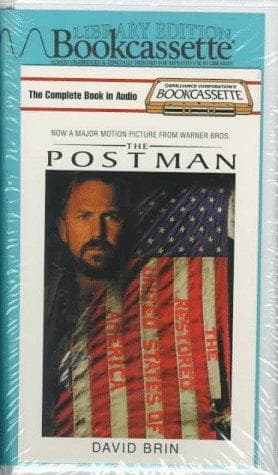
The Uniform Was Always the Message
David Brin wrote a novel about a man who puts on a dead postman's uniform and discovers that the costume is more powerful than the man inside it. In 1985, this was a parable about the fragile persistence of institutional memory after nuclear war. In 2026, it reads like a diagnostic manual for how symbols operate in the absence of the institutions they once represented. Gordon Krantz is a fraud who becomes real through repetition, a man who performs government until government starts to exist again — not because anyone rebuilt the infrastructure, but because enough people decided to act as though it had been rebuilt. Brin set this in 2013, which is almost perversely apt: the year Edward Snowden revealed the actual machinery behind the American state's symbols, the year the gap between what institutions claimed to be and what they were became impossible to ignore. Brin imagined the uniform surviving the republic. He did not imagine the republic surviving while its uniforms hollowed out from within.
The novel's most uncomfortable prescience lies not in its nuclear scenario — Brin's "Doomwar" is a composite of Cold War anxieties that never materialized in quite that form — but in its portrait of the Holnists. Nathan Holn's philosophy, a toxic brew of social Darwinism, feudal loyalty hierarchies, and contempt for democratic institutions, was meant to represent the survivalist fringe of Reagan-era America. Forty-one years later, the Holnist playbook reads less like fringe ideology and more like a recognizable political template: the insistence that the political spectrum is a manufactured illusion, the valorization of strongman loyalty structures, the explicit rejection of due process as weakness. Brin even gives the Holnists their own media — Holn's book circulates as a kind of post-apocalyptic manifesto. What he could not have anticipated is that such ideas would not require an apocalypse to gain traction. The survivalist bunker mentality migrated from the Oregon woods to mainstream discourse without the courtesy of a nuclear winter to justify it.
Where the novel shows its age most clearly is in its gender politics, which oscillate between genuine aspiration and the limitations of a 1985 male liberal imagination. Dena's feminist army and the legend of the forty women who vowed to end the war are clearly meant as progressive gestures, but they operate within a framework where women's primary narrative function is to either inspire men, seduce men, or sacrifice themselves to shame men into action. The intimate scenes with Abby and Dena serve Gordon's character arc more than they illuminate the women as autonomous agents. Brin reaches for something he can sense but cannot quite articulate — a world where women's political agency is structural rather than symbolic. Octavia Butler, writing *Lilith's Brood* just four years later, would push this question much further, examining survival and rebuilding through bodies and biology rather than uniforms and postal routes. The lineage is visible but the leap is significant.