The Utopia That Ate Its Author
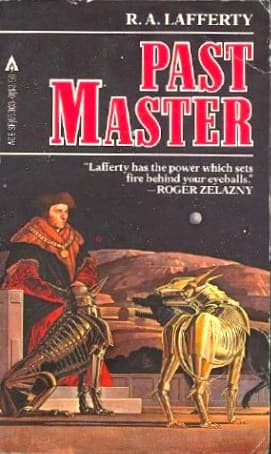
Lafferty wrote a book about a man kidnapped by his own creation, and then the future did the same thing to the book. *Past Master* drags Thomas More—the actual Thomas More, plucked from 1535—forward to a planet called Astrobe, humanity's "third chance," where his satirical *Utopia* has been built in earnest and is killing people. The golden cities function. Everyone is fed. Individuality has been dissolved into a collective urban organism. And people are fleeing in droves to the filthy, toxic slums of Cathead, choosing misery and early death over perfection. In 1968 this read as Catholic surrealism with a Cold War edge, a rebuke to technocratic utopianism dressed in Lafferty's characteristic linguistic delirium. In 2026 it reads as something closer to a diagnostic manual. The Programmed Killers that stalk dissidents are not robots in the pulp sense; they are enforcement systems, autonomous and persistent, deployed by a regime that has confused optimization for governance. We have not built them in chrome, but we have built them in code—content moderation algorithms, predictive policing systems, automated denial engines in insurance and immigration. The killers are programmed. That was the point. The "One Great City" that absorbs all variation into a single managed experience is less a Soviet metaphor now than it is a description of platform consolidation: one feed, one interface, one acceptable mode of participation, with the Cathead slums recast as whatever off-grid or analog existence people claw their way toward when the frictionless world becomes unbearable. Lafferty saw that the problem with utopia is not that it fails but that it succeeds.
What he got wrong, or rather what he could not see past, is the Church. *Past Master* is saturated with Catholic eschatology. The decline of institutional religion on Astrobe is presented as a wound, the absence of the sacred as the root cause of civilizational sterility. Lafferty assumes that without the Church, meaning collapses. This is a 1968 Catholic intellectual's anxiety, and it shows. In the actual 2020s, institutional religion has indeed receded in much of the developed world, but the hunger for meaning has not produced the specific vacuum Lafferty imagined. It has produced conspiracy spirituality, algorithmic radicalization, wellness cults, political religions of left and right—a thousand substitute liturgies, none of them nothing. The "Ouden-Nothingness" god that haunts the book is a real phenomenon, but it wears more faces than Lafferty allowed. His blind spot is not that he was wrong about the sacred; it is that he could not imagine the sacred going feral rather than simply dying. The feral strips in his own novel—those wild zones where psychic forces manifest physically—are a better metaphor for what actually happened to spirituality than his explicit theological framework admits. The book is smarter than its author's intentions.