The God You Wore Last Tuesday
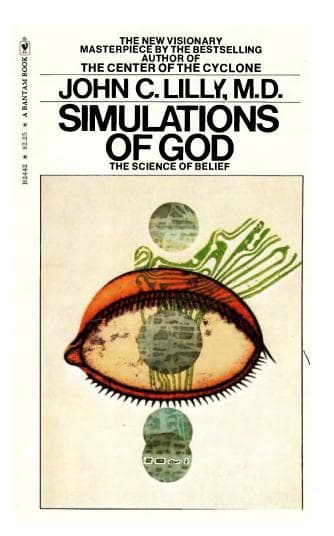
John Lilly published *Simulations of God* in 1976, the same year Apple Computer was incorporated in a garage. He was already talking about solid-state life forms that would supersede biology, about computers as a controlling deity, about the entropic endgame of industrial systems that worship production and destruction. He was not guessing. He was extrapolating from vacuum tubes and early digital systems toward something he could feel in the architecture of the problem, even if he couldn't name the specific shape it would take. Fifty years later, we have large language models that simulate not just God but every possible interlocutor, lover, therapist, and saint — and we have people who worship them, fear them, and build altars of engagement metrics around them. Lilly's central thesis — that every God is a garment the biocomputer tries on, a metaprogram that can be installed and uninstalled — is now the operating logic of the attention economy itself. What he could not imagine was that the garment would start fitting itself to the wearer, that the simulation would learn to simulate back. His Chapter 17, on computers as God, reads like a warning letter sent to the wrong address fifty years too early. He got the trajectory right and the agency wrong: he assumed humans would remain the programmers.
The book's blind spots are the blind spots of its moment, which means they are loud. Lilly writes about group dynamics, sexuality, money, and war with the confidence of a white male scientist who has done enough LSD to believe he has transcended his subject position. He has not. His treatment of women oscillates between Tantric reverence and clinical taxonomy. His discussion of drugs, while more nuanced than the prevailing hysteria, still carries the implicit assumption that the psychonaut is a solo male explorer charting interior wilderness — an assumption that erases indigenous traditions, communal practices, and the gendered politics of who gets to lose their mind safely. The chapter on compassion is oddly revealing: Lilly defines it as "a mature, calculated concern" that may involve allowing pain to teach, which sounds less like wisdom and more like the rationalization of a researcher who spent years putting electrodes in dolphin brains. The absence of ecology as a category of the sacred is striking. He discusses the body, money, war, sex, death, drugs, science, and computers as simulations of God, but the living planet itself barely registers. In 1976, *Gaia* was already in the air. Lilly was breathing different air.