The Pleasure District Has a Login Screen Now
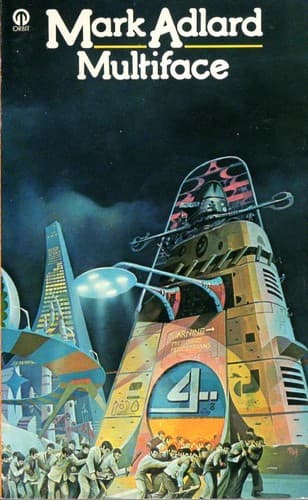
Mark Adlard's *Multiface* opens with a man walking to work through a city that has solved all the problems except the ones that matter. Will Forstell is a clerk—not starving, not oppressed in any way the state would recognize, but hollowed out by the specific emptiness of having nothing meaningful to do while being required to show up and do it. His compensation arrives weekly in the form of engineered pleasure zones, synthetic companions, and environments so carefully designed they've eliminated the possibility of surprise. Tcity is not a dystopia of jackboots and telescreens. It is a dystopia of adequate amenities. That distinction, unremarkable in 1978, now reads like a diagnosis.
What Adlard got right is the texture of managed contentment. The aphrodollies—synthetic beings calibrated for human gratification—are less interesting as predictions of sex robots (though that conversation has certainly arrived) than as predictions of the algorithmic pleasure loop. The First Sector's pleasure grounds operate on the same logic as a recommendation engine: identify desire, fulfill it frictionlessly, repeat. Will's weekly visits have the compulsive rhythm of a scroll session. He doesn't enjoy them so much as require them, and the difference between those two states is the book's quiet engine. Adlard understood that the threat wasn't deprivation but satiation—that a society could neutralize dissent not by forbidding pleasure but by industrializing it. In 2026, with engagement metrics governing everything from news delivery to pornography, this is no longer speculative. It is operational.
The blind spots are period-typical. Tcity is centrally planned, monolithic, its uniformity enforced by architecture and bureaucracy—a vision that owes more to postwar British town planning and Soviet housing blocks than to anything resembling the distributed, privatized, algorithmically personalized control structures we actually got. Adlard imagined the future as a single employer, a single aesthetic, a single city logic. He could not imagine that the monoculture would arrive wearing a thousand faces, each one tailored to an individual user. The book's title, *Multiface*, gestures toward multiplicity and fractured identity, but the world it builds is strangely uniform. The real multiface turned out to be the interface itself—adaptive, personalized, showing each person exactly the version of reality most likely to keep them seated. Adlard also inherits the era's gender assumptions without much interrogation; the aphrodollies exist as objects of male consumption, and the narrative doesn't seem particularly troubled by this, which limits the book's capacity to interrogate its own premises.