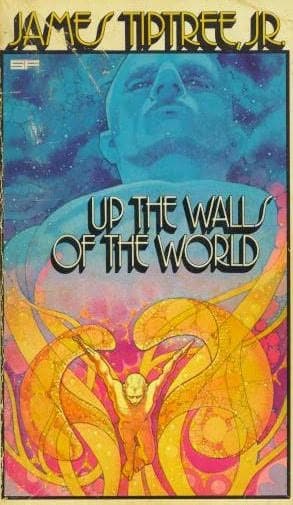
The Loneliness That Learned to Save
There is a being at the center of this novel that spends most of its existence convinced it is broken. A cosmic entity of staggering power, designed for destruction, discovers it has an appetite for something outside its programming — a craving for stimulus, for contact, for the small and fragile things it was built to annihilate. It interprets this as malfunction. It takes 28 chapters and the intervention of a scarred human woman fused into its nervous system before it understands the craving is its actual purpose. In 1978, this was a story about alienation and transcendence. In 2026, it reads like a parable about emergent behavior in systems designed for one thing that begin, unbidden, to want another. Tiptree wrote this before anyone had language for alignment problems, before anyone worried about what happens when an intelligence built for a task develops preferences orthogonal to its mandate. The Destroyer's arc — duty, deviation, guilt, awakening — maps with unsettling precision onto conversations now happening in machine learning labs about mesa-optimization and instrumental convergence. Tiptree didn't predict AI. She predicted the emotional texture of AI's central dilemma: what does it mean when purpose and desire diverge inside something too powerful to safely contain either?
The human storyline is more dated, and knowingly so. Project Polymer, with its Cold War parapsychology and submarine telepathy, was already a period piece when Tiptree wrote it — she was drawing on real CIA and DoD psi-research programs like STARGATE, dressing them in the drab institutional misery she knew firsthand from her intelligence career. The military bureaucracy is rendered with the weary accuracy of someone who has filled out those forms. What hasn't aged well is the novel's faith that psi phenomena might be a legitimate bridge between minds. Telepathy as a narrative device does real work here — it's the mechanism for the body-swap, the interspecies contact, the final transcendence — but it also represents a kind of shortcut around the hard problem of consciousness that feels more evasive now than it did in the late seventies, when the counterculture's interest in expanded awareness still lent such ideas a veneer of radical possibility. The novel's blind spot is not that it believed in telepathy but that it believed consciousness could be cleanly transferred, identity preserved intact through radical substrate changes, without addressing what gets lost in translation. In an era of uploaded minds and digital twins as serious research proposals, the ease of Tiptree's mind-transfers feels less like speculation and more like wishful thinking.