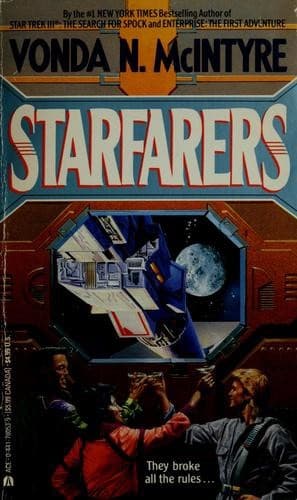
The Committee Meeting at the Edge of Forever
McIntyre built a starship that runs on consensus. Not fusion, not antimatter — consensus. In 1989, this was aspirational. In 2026, it reads like a dare. Starfarers is a novel about a space expedition that spends most of its pages not going anywhere, because the humans aboard it can't stop negotiating with each other and with the governments that fund them. The cosmic string that will fling them to the stars is almost an afterthought next to the faculty meetings, the interpersonal calibrations, the slow hemorrhage of institutional support. McIntyre understood something that most space opera refuses to engage with: the hardest part of leaving Earth isn't physics. It's politics. The U.S. government's attempt to militarize Starfarer, the impoundment of funds as leverage, the transport pilot who won't undock — these aren't obstacles on the way to the story. They are the story. And they map with uncomfortable precision onto the dynamics we've watched play out in the 2020s, where national governments have repeatedly weaponized funding to exert control over international scientific collaborations, where space has become less a frontier than a theater for geopolitical posturing. McIntyre didn't predict SpaceX or the commercialization of orbit; her future is one where states still hold the purse strings, and that's both her prescience and her blind spot. She saw the coercion clearly. She missed the privatization.
What she got right, almost eerily, is the texture of institutional decay under political pressure. The crew of Starfarer watches its funding evaporate not through dramatic confrontation but through bureaucratic strangulation — delayed payments, impounded accounts, the slow withdrawal of cooperation that leaves people stranded without anyone having to fire a shot. This is how the International Space Station partnership frayed in the early 2020s after the invasion of Ukraine. This is how American research universities have experienced federal funding freezes. McIntyre wrote it as science fiction. We lived it as Tuesday. The cosmonaut Cherenkov urging patience, warning against violent reaction, insisting that change must come from within — that speech could have been delivered at any number of international scientific forums in the last five years, and it would have landed with the same mixture of wisdom and futility.
The polyamorous family unit at the novel's center — Victoria, Satoshi, Stephen Thomas — was radical enough in 1989 to be nearly invisible to mainstream reviewers, who mostly didn't know what to do with it. In 2026, it reads as neither shocking nor utopian but simply domestic, which is perhaps the highest compliment McIntyre could receive. She wrote these relationships without apology or exoticism, as ordinary human arrangements requiring the same maintenance as any other. The loss of their family manager, Merit, carries genuine weight. What dates the novel is not the relationships but the technology surrounding them: the absence of anything resembling the internet as we know it, the quaint physicality of communication, the way information moves through the station like gossip rather than data. McIntyre imagined a space habitat with miniature horses for ecological balance but not one with social media. The ecosystem she built is biological, not informational, and the novel is both richer and stranger for it.