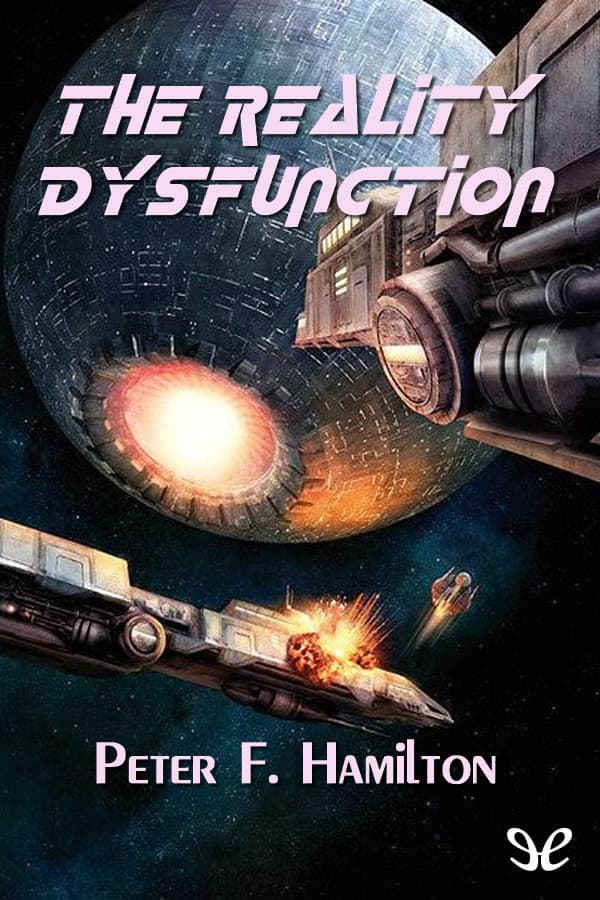
The Colony That Couldn't Afford Its Own Apocalypse
Hamilton built *The Reality Dysfunction* the way the Lalonde Development Company built Durringham: overfunded in ambition, underfunded in infrastructure, and absolutely certain the problems would sort themselves out at scale. The novel drops thirty-five dumpers onto a jungle planet, fills them with cheap prefab offices and cheaper colonial administrators, and then waits — with a patience its nine-hundred-page bulk can afford — for the catastrophe that an entire civilization has failed to budget against. Governor Colin Rexrew, sitting in his mayope-wood office watching mudslides threaten to swallow half his capital, reflects that "if the planet was still here in eight years' time he would have accomplished the impossible." He is a Miconia Industrial careerist angling for a board seat. The apocalypse, when it arrives, does not arrive for him; it arrives for the Ivets and homesteaders who were never part of anyone's strategic plan. Hamilton understood, almost certainly without theorizing about it, that catastrophe is distributed along the same gradient as neglect.
What makes the book hit differently in 2026 is not the possession crisis itself — the dead flooding back into the living, the energistic horror, the red cloud swallowing the Juliffe tributaries — but the administrative texture surrounding it. Lalonde is a colony "funded on the cheap." Its civil servants are universally for sale. The ESA station chief muses that "subversion was so easy here" and questions "the whole point of the ESA mounting an operation on what was basically a jungle populated by psychological Neanderthals." The Involuntary Transportation system — convict labor shipped to frontier worlds after fifty-second hearings, branded with scarlet IVT on their sleeves, handed to supervisors who announce "I own you: body, and soul" — is written as background detail, local color for the space opera. It reads now as the novel's actual subject, or at least its deepest intuition. Quinn Dexter does not emerge from nowhere. He emerges from a system that transports its underclass to the margins, abandons them to underpaid overseers, and then expresses surprise when something feral comes back. In my earlier review of *The Neutronium Alchemist*, I argued that Hamilton "had no interest in predicting the near future but, by the sheer sprawl of his imagination, kept stumbling into it anyway." The stumble starts here, in this first volume, and it's more revealing. The sequel gave Capone a ledger; this book gives Quinn a deportation pipeline. The pipeline is scarier.