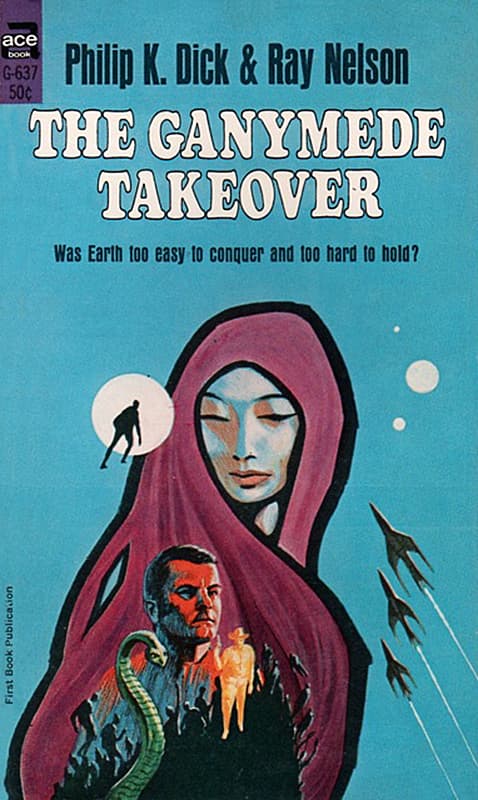
The Common That Couldn't Hold
The Ganymedians call their shared consciousness the Common, and Dick stages the Grand Council of their ruling class seated in two blocs: the Clock Faction and the Anti-Clock Faction, the former having pushed through the war against Earth, the latter — Mekkis's people — having opposed it and lost. It is the single most Dickian detail in a book full of candidates: an empire's foreign policy reduced to seating arrangements, a species that reads minds collectively still organizing itself by petty parliamentary grudge. Nothing here is streamlined. Nothing is efficient villainy. The occupation of Earth runs on committee politics, patronage, factional resentment — Mekkis gets "the dregs" of Tennessee as a demotion, not a strategy. Fifty-five years on, this is the part that still lands: colonization imagined not as a coherent machine of control but as a bureaucracy staffed by the demoted and the sulking, administering a planet they privately regret having taken.
The novel's real wager, though, is the one it makes with its own premise of hive-mind superiority. The ruling elite survives by merging into what the text calls the polyencephalic mode — losing the individual self into collective telepathic unity whenever danger threatens, on the theory that unity is strength. When "something came through the Great Common," a malignant force whose nature the book never fully explains, it kills them precisely because they merged into it together: "the more frightened they became the more they tried to lose themselves in unity — and thereby exposed themselves." A medical creech watching from a nearby ship narrates the extinction of an entire ruling class in one paragraph, almost as an aside. Read against a decade of conversation about model collapse, algorithmic monoculture, and the single point of failure introduced whenever a system optimizes for shared architecture over redundancy, this lands with a specificity Dick could not have intended and the book does not dwell on. The vulnerability was never the individual mind. It was the merger itself — the thing built to be strongest turning out to be the one thing that couldn't be quarantined once something got in.
Joan Hiashi's arc is where the novel's politics get uncomfortable in a way that has aged oddly rather than badly. Dr. Balkani diagnoses her Neeg-part religion — her solidarity with a Black resistance movement — as "psychic masochism," a mental illness to be cured through sensory deprivation he administers with the bedside manner of a man running an experiment on a specimen he finds tedious. "Give my regards to oblivion, Miss Hiashi," he tells her before the helmet goes on. The cure works, in the sense that it produces exactly the flattened, compliant affect he wanted, and he keeps a robot duplicate of her afterward for company, ordering it to undress with the same tone he'd use on an appliance. The book treats this as body horror and black comedy simultaneously, and the discomfort is the point Dick is actually making, even if he makes it through a 1971 lens that reduces Percy X's Black separatist movement to the "Neeg-parts" and mediates nearly all of it through white characters' eyes. The pathologizing of res