The War That Dreamed Itself
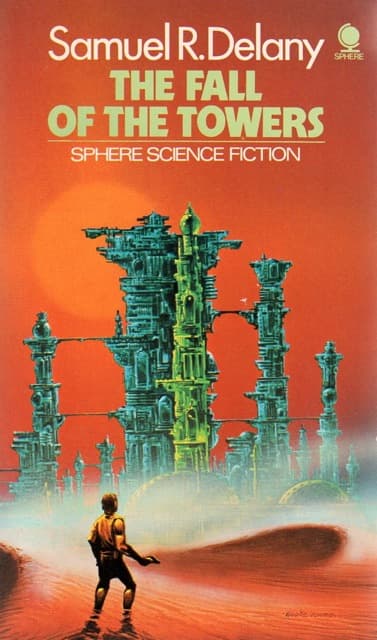
Delany was twenty when he started writing *The Fall of the Towers*. This matters — not as biography but as structural fact. The trilogy (originally published 1963–65, revised and collected in 1971) has the ambition of a writer who has read everything and lived almost nothing, and that imbalance produces something peculiar: a book that gets the shape of systemic failure exactly right while filling it with characters who speak like philosophy seminars. Toromon, the last human empire, is sealed behind a radiation barrier, choking on "great excess and little mobility" — Clea Koshar's diagnosis of the economic crisis that "must mean war." She's describing the logic of a system that can only maintain itself through catastrophic expenditure. Delany was writing about Vietnam-era America, obviously. But he was also writing about something more general, and the generality is what has lasted.
The revelation at the trilogy's center still startles. There is no war. The soldiers of Toromon sit "in tiny metal cells stacked up like coffins," drugged on sodium pentathol, dreaming coordinated combat hallucinations fed by a computer that transposes "whole sensory patterns from one brain" to another. Six weeks of basic training "formally designed to make a psychotic of the steadiest mind" provides the substrate; three years of propaganda supplies the texture. The soldiers fight desperately to dream their way back to reality, but every real sensation — "the sound of wrinkling sheets, the glitter of sun on water, the feel of wet cloth" — gets absorbed into the war-dream's mosaic. In 1965, this was surrealism. In 2026, after two decades of drone operators killing from office chairs, after the revelation that algorithmic recommendation systems can radicalize millions into wars that exist primarily as media events, after we watched an insurrection organized in a shared hallucination-space called social media — the mechanism Delany described has become less metaphor than engineering diagram. The psyche officer's confession at the bar is the passage that cuts deepest now: "We controlled all the propaganda that went to civilians too. . . . We'd done our propaganda job already, laid the grounding for all the uncertain and doubting intellectuals to do the rest." The military didn't need to write the novels and articles that made war seem real and valid. They just set the conditions; the intellectuals did the rest voluntarily. That is a precise description of how narrative capture works in 2026, and Delany wrote it before he could legally drink.