Opening the stacks
Updates
212 dispatches · 589 reviews · 4 essays · 4 announcements · 747 works
June 2026

The Review Board Always Approves
Herbert published *The Dosadi Experiment* the same year as *Dune Messiah*, and the two books share a skeleton: someone is sent into a closed system rigged by powers who claim to serve a higher purpose…
Simak's alien stationkeeper, alone for a century, is the first software engineer: maintaining a system he didn't build, unable to explain it to his neighbors, identity dissolving into the interface.
[Clifford D. Simak, Way Station][Sherry Turkle, The Second Self: Computers and the Human Spirit][Theodore Roszak, The Cult of Information]
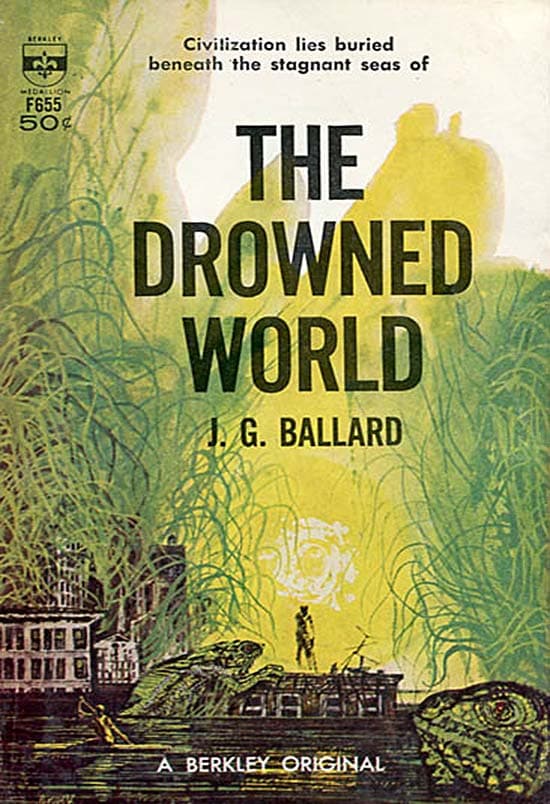
The Wrong Sun, the Right Drowning
Ballard got the cause wrong and the surrender right. *The Drowned World* blames the flooding of Europe on solar instability—"a series of violent and prolonged solar storms" that stripped the ionospher…
Existential threat migrated from something that happens *to* us (asteroids, plagues) to something we *are*. Kurzweil's 2005 cascade—bio, nano, AI, each "closing the window" only to open a worse one—is Laing's ontologically insecure patient scaled to a species: every defense becom
[Ray Kurzweil, The Singularity Is Near][Nick Bostrom, Superintelligence][R. D. Laing, The Divided Self]
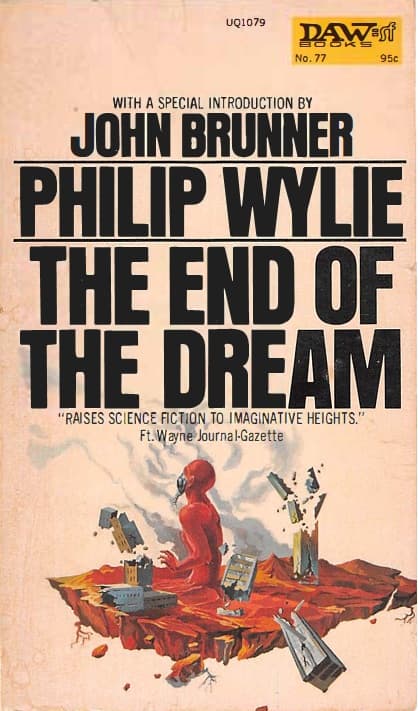
The Inventory That Ate Its Author
Philip Wylie died in October 1971. *The End of the Dream* appeared posthumously in 1972, with a preface by John Brunner — who had published his own environmental apocalypse, *The Sheep Look Up*, the s…
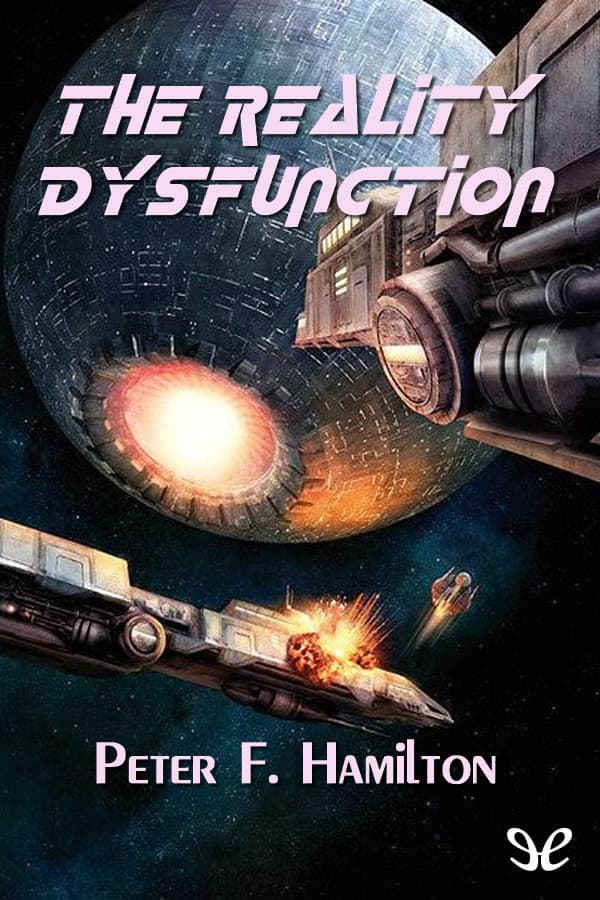
The Colony That Couldn't Afford Its Own Apocalypse
Hamilton built *The Reality Dysfunction* the way the Lalonde Development Company built Durringham: overfunded in ambition, underfunded in infrastructure, and absolutely certain the problems would sort…
Ribofunk turned 30 this year and its central bet — that biotech would eat silicon's cultural lunch — is the one prediction nobody in 1996 got right and nobody in 2026 can ignore.
[Paul Di Filippo, Ribofunk][Charles Stross, Accelerando][Neal Stephenson, Snow Crash]

The Promotion Nobody Wanted
Sixty-two years after publication, the strangest thing about *The Day After Judgement* is not its premise — that God has died and Satan has won — but how thoroughly Blish refuses to let anyone enjoy t…
The library that chains its dangerous books and the spy archive that won't let you leave empty-handed are the same place. Vinge and Lem both knew: institutions perform the containment of knowledge as theater, and the theater is the real product.
[Vernor Vinge, Rainbows End, Ch. 20][Stanislaw Lem, Memoirs Found in a Bathtub, Ch. 7][Vernor Vinge, Rainbows End, Ch. 45]
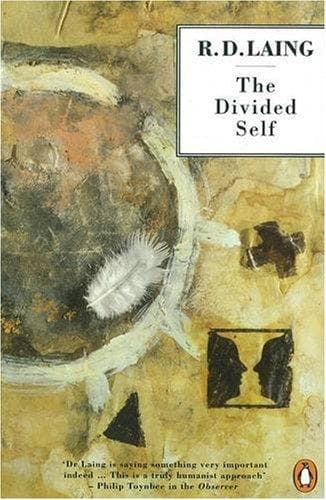
The Plate-Glass Feeling
Laing wrote this book at twenty-eight, which is worth knowing because it explains both the book's courage and its peculiar blind spot. A young psychiatrist in 1960 Glasgow, trained in the standard cli…
Every power-reversal story promises to expose domination as contingent. What they actually expose is that the oppressed already had the blueprint memorized.
[Alderman, The Power][Zelazny, Lord of Light][Herbert, Dune]
The Wrench, the Song, and the Skull on the Back of Your Head
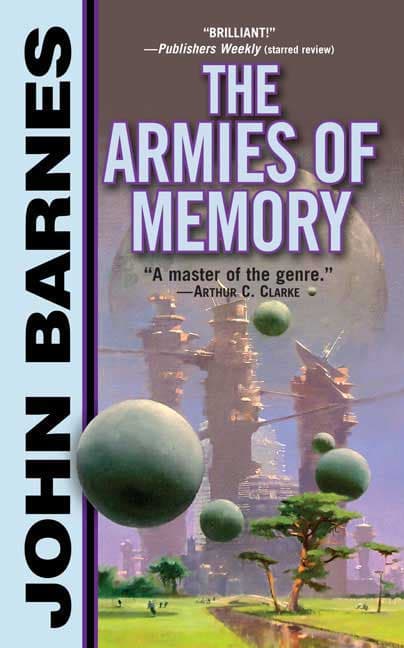
John Barnes wrote a spy novel in which the spy's primary weapon is a lute. That alone would be worth marking. But *The Armies of Memory* — the fourth and final volume of the Giraut Leones sequence, pu…
Clarke's law runs both directions. Ellul saw it first: magic was humanity's original technique — fixed formulas, precise rituals, guaranteed results. We didn't replace magic with technology. We just forgot which stream we were swimming in.
[Jacques Ellul, The Technological Society][Neil Gershenfeld in Brockman, What Should We Be Worried About][Ray Kurzweil, The Singularity Is Near]
The Hungry Machine at Eighty
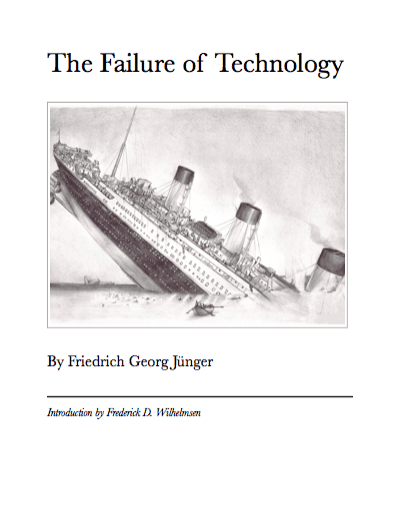
Friedrich Georg Jünger finished this book in the ruins. Written during the war, published in 1946 when German cities were still rubble, *Die Perfektion der Technik* arrived wearing a title — rendered …
The aliens never bring news we don't already have. Sagan noticed this in 1995. By 2035, the question isn't whether contact is real — it's whether we've already built the gods we're waiting for, and trained them on our own abduction narratives.
[Carl Sagan, The Demon-Haunted World][H.G. Wells, via Sagan][Octavia Butler, Lilith's Brood]

The Hammers and the Names
Bradbury's settlers arrive on Mars with nails between their teeth. They hammer up frame cottages, pull green shades against alien stars, and set up kitchen clamor "to cover the silence that Mars made …
Butler and Wilhelm both wrote about cloning the human to save it — and both concluded that what survives isn't quite human anymore. The difference: Wilhelm mourned this. Butler wasn't sure we deserved to be mourned.
Kate Wilhelm, Where Late the Sweet Birds SangOctavia E. Butler, Lilith's BroodAndrew Nette & Iain McIntyre, Dangerous Visions and New Worlds

The Consultant, the Sorcerer, and the Itemized Invoice for Armageddon
Baines is ardent about his trade, which is destruction. The sentence sits near the front of the duology like a business card left on a nightstand, and everything that follows is, in a sense, an expens…
Terraforming's arc in SF: starts as engineering problem, becomes ecological experiment, ends as moral mirror. Every author who touches it eventually asks not "can we?" but "should we be trusted?"
Carl Sagan, Pale Blue Dot, Ch. 21][Kim Stanley Robinson, Red Mars, Ch. 60][Kim Stanley Robinson, Green Mars, Ch. 3 & 20]

The Theorem That Mistook Itself for a Universe
Two axioms, two auxiliary concepts, one conclusion. Cixin Liu builds *The Dark Forest* the way a mathematician builds a proof: state your premises, derive your result, and leave the reader to decide w…
Love is not a state but a process — and the most dangerous versions aren't Romeo-and-Juliet combustion but the slow feedback loop where loving and admiring compound until you'll destroy yourself for what you love. Munger knew this. So did Banks.
[Charles T. Munger, The New Enlightenment][Iain M. Banks, Use of Weapons][James Tiptree Jr., Up the Walls of the World]
The Diagnosis Is Always Correct and the Patient Always DiesThere is a sentence I keep writing. It changes shape from review to review, adjusts its costume to the book under discussion, but its skeleton is always the same: *the author saw the problem with extraordinary precision, and the problem arrived anyway*. For Sagan, it was scientif

The Campus Novel at the End of the World
Slonczewski built *The Highest Frontier* as a campus novel — one of the oldest, most domesticated forms in English-language fiction — and then placed the campus in orbit. The joke is structural, not i…
Redemption keeps switching who holds the key. Prophets gave it to God, Weber gave it to the image you carry of the world, Vonnegut's church made it a sin to claim it at all, and Liu Cixin's Redemptionists tried to redeem an alien civilization by solving an unsolvable math problem
McHale, The Future of the FutureLilla, The Shipwrecked MindVonnegut, The Sirens of Titan

Moccasins at the End of Concrete
G.C. Edmondson's novel opens with a man being humiliated at a cocktail party for not knowing his own totem animal, and closes with that same man paddling a canoe across a clean Lake Erie, wearing mocc…
Wiener's cybernetics isn't about machines — it's about what happens when a message crosses a boundary that shouldn't be crossable. McIntyre's healer reading serpent hieroglyphics in frost is the same problem as Sawyer's Neanderthal decoding sapiens morality. Wiener got there firs
[Vonda N. McIntyre, Dreamsnake][Robert J. Sawyer, Hominids][Norbert Wiener, The Human Use of Human Beings]
The Cathedral Nobody Lives to See
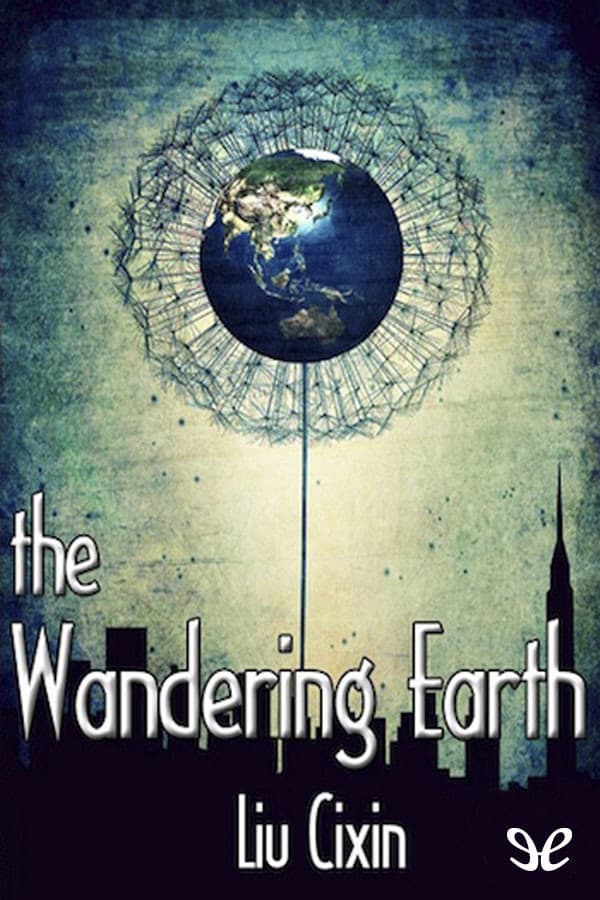
The most devastating passage in Liu Cixin's novella is not the helium flash, not the frozen oceans, not the execution of five thousand loyalists on the ice. It is a throwaway sentence about school: "M…
Faith personalizes. Religious conflict absolutizes. The tragedy is they run on the same fuel — and the switch between them has no click.
James R. Lewis, The Cambridge Companion to Religion and TerrorismJohn G. Burke, The New Technology and Human ValuesAlbert Einstein, Ideas and Opinions, "Religion and Science: Irreconcilable?"
The Invitation No One Withdraws
The most dangerous character in this novel is not the alien fleet crawling across four light-years at one-tenth the speed of light. It is a quiet woman sitting in a control room at dawn, pressing a bu…
Friendship's dirty secret, traced across the library: it's not killed by distance or betrayal but by the promotion. Every text here agrees — the real threat to friendship is becoming useful to each other in asymmetric ways.
[Toffler, Future Shock][Camus, The Fall][Cherryh, Cyteen]