The Sun Also Rises on Real Estate
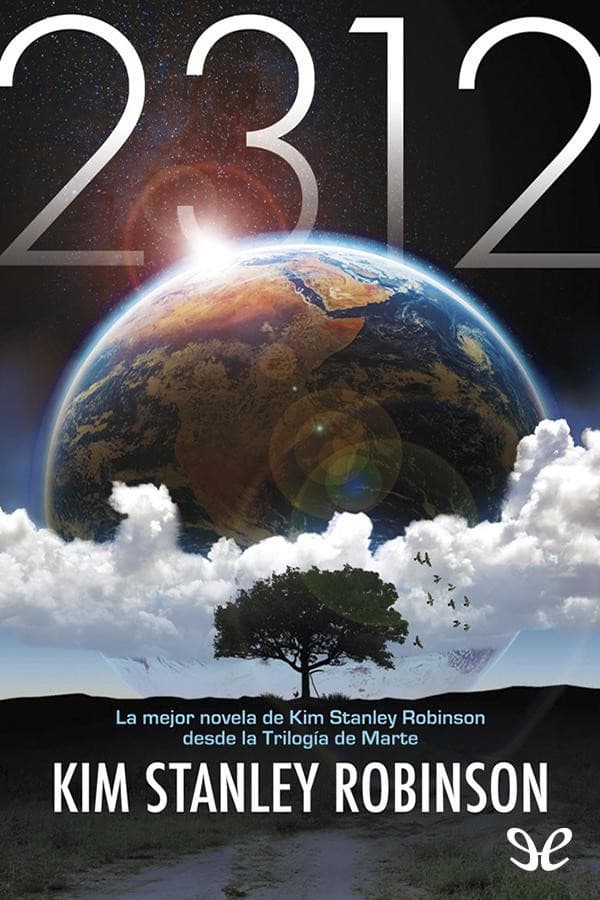
Kim Stanley Robinson published *2312* in the last year anyone could still pretend the Holocene was holding. That timing matters. The novel is a love letter to planetary engineering written at the precise moment Earth's engineering of its own planet was becoming undeniable, and Robinson knew it — the book's Earth is a drowned, diminished thing, a source of refugees rather than ambition, while the rest of the solar system hums with terraria and quantum computers and gender fluidity so thorough it has become unremarkable. The Mercury of the opening chapters, with its rail-riding city Terminador forever fleeing sunrise on thermal expansion tracks, remains one of the most elegant pieces of infrastructural worldbuilding in the genre. It is a city whose existence is a physics problem solved by elegance. Robinson was always better at cities than people, and he has never been more transparent about it than here.
What the book got right, from the vantage of 2026, is less about specific technologies than about trajectories of feeling. The novel anticipated our current entanglement of ecological grief and technological optimism — the sense that we might terraform Mars while failing to manage Iowa. Robinson's Earth in 2312 is not destroyed but *diminished*, left behind by those with means, a place where the biosphere collapses slowly enough that people adapt rather than revolt. In 2012 that read as cautionary. In 2026 it reads as journalism. The book also foresaw a post-gender social landscape with more accuracy than most of its contemporaries; its casual treatment of bodily modification and sexual fluidity now looks less like speculation and more like an extrapolation of trends already visible in Gen Z discourse. Where it stumbles is AI. Robinson's quantum computers, or "qubes," are treated as oracles and possible persons, but the novel never anticipates the more mundane and pervasive reality: that artificial intelligence would arrive not as a philosophical puzzle about consciousness but as a labor displacement engine and a generator of plausible-sounding nonsense. The qubes are too dignified. They lack the banality of what actually showed up.
The blind spots are instructive. Robinson, for all his leftist bona fides, built a solar system whose political economy runs on a vaguely Mondragon-style cooperative model without ever quite grappling with how the transition happened. The novel assumes that once you leave Earth's gravity well, you leave its power structures. Fourteen years later, with billionaires openly competing to own orbital infrastructure and national governments treating space as a military domain, that assumption looks less like optimism and more like the specific optimism of a Californian who came of age reading Murray Bookchin. The book is also strangely quiet about information warfare, surveillance, and the weaponization of narrative — the defining political technologies of our actual decade. Robinson imagined people might hollow out asteroids and fill them with ecosystems. He did not imagine they might hollow out consensus reality and fill it with nothing.