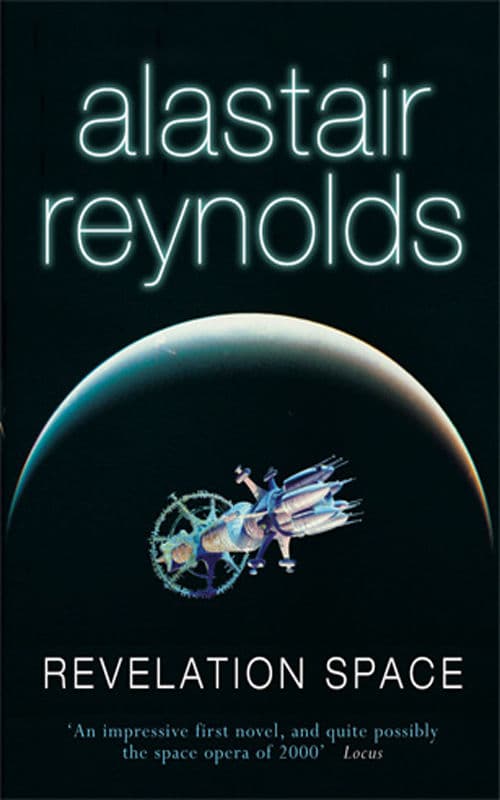
The Watchmaker's Galaxy
Twenty-six years on, Revelation Space reads less like a novel and more like a dossier compiled by someone who understood the shape of the problem before anyone had named it. Reynolds, an astrophysicist writing at the bleeding edge of the millennium, built a universe governed by a single ruthless premise: the Fermi paradox is not a puzzle but a verdict. Intelligent life is rare not because it fails to arise but because something exterminates it when it gets too loud. In 2000, this was a dark flourish for a space opera. In 2026, after two decades of increasingly refined astrobiology, the "Great Filter" hypothesis has migrated from speculative fiction into respectable scientific discourse, and the silence of the cosmos feels less like an open question and less like a storytelling device. The Inhibitors — ancient machines seeded across the galaxy to suppress civilizations before they become existential threats — now sit uncomfortably close to how we talk about autonomous weapons systems, algorithmic enforcement, and the logic of preemptive suppression. Reynolds didn't predict drones or lethal autonomous weapons per se, but he grasped the grammar: that a sufficiently old civilization might decide the cheapest solution to risk is automated annihilation, and that such systems would outlast the intentions of their creators by geological timescales.
What Reynolds got right about decay is almost more impressive than what he got right about destruction. The Nostalgia for Infinity — a kilometers-long lighthugger rotting from the inside, its Captain fused with a plague that blurs the line between biology and machine — is one of the great images in modern science fiction, and it has only sharpened with time. The Melding Plague, a pathogen that corrupts nanotechnology and flesh alike, anticipated our current anxieties about biosecurity, gain-of-function research, and the fragility of complex technological systems in ways that feel almost documentary. We live now in a world where a single misaligned update can cascade through global infrastructure, where the boundary between software failure and biological catastrophe has thinned. The plague's indifference to categories — organic, mechanical, computational — mirrors the way our own systems have become so entangled that a vulnerability in one domain propagates instantly into others. Reynolds also understood, before most writers did, that interstellar civilization would not be a gleaming federation but a patchwork of factions, cults, and post-human splinter groups held together by nothing more durable than mutual suspicion. The Ultras, Conjoiners, Demarchists — these feel less like genre furniture now and more like plausible sociological projections of what happens when technology fragments identity faster than politics can unify it.