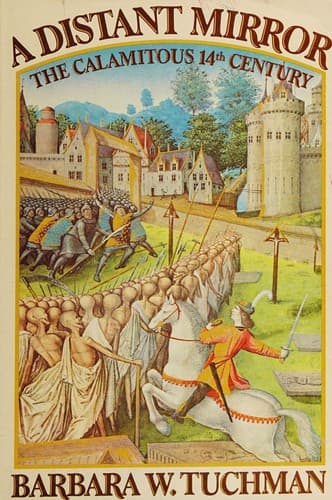
The Confessions Arrived by Mail
The Jews of Savoy were arrested in September 1348. Their property was inventoried and held while they sat in prison awaiting trial; the confessions, when they came, were extracted by torture and described an international conspiracy running out of Toledo, poison carried in "a narrow stitched leather bag," rabbinical instructions passed at secret meetings. Eleven people were burned. The survivors were taxed 160 florins a month for six years for the privilege of remaining where they were. Then the confessions were copied and sent, by letter, from town to town along the Rhine — Strasbourg, Basel, into Germany — so that the next town's tribunal would not have to invent its own conspiracy from scratch. Tuchman's sentence for this is the one that stays with you: "The persecutions of the Black Death were not all spontaneous outbursts but action seriously discussed beforehand."
Discussed, documented, taxed, and mailed. That's the part of *A Distant Mirror* that a reader in 2026 recognizes with a jolt that has nothing to do with the plague itself.
Tuchman tells you exactly why she wrote the book, in a Preamble that is refreshingly unembarrassed about its own motive. She was not trying to predict anything. She was trying to be comforted. "If our last decade or two of collapsing assumptions has been a period of unusual discomfort," she writes, meaning Vietnam, Watergate, the oil shocks, "it is reassuring to know that the human species has lived through worse before." She cites another historian, James Westfall Thompson, who'd already run the same comparison between the Black Death's aftermath and the aftermath of the First World War and found the identical inventory of symptoms — profiteering, hysteria, maladministration, "frenetic gaiety." Voltaire gets quoted approvingly: history never repeats itself, but man always does. This is not a book built to warn a future audience. It's a book built to soothe a present one, by handing it a worse century to stand next to.
The soothing has not aged the way she might have hoped. We have since lived through an actual pandemic, and the record of it tracks her fourteenth century with a fidelity that should unsettle anyone who found her Preamble comforting. The scapegoat relocated from the Jewish quarter to Wuhan and to anyone who looked like they might have come from there; the poisoned wells became poisoned 5G towers and contaminated vaccines; the papal bulls trying and failing to hold back the mob became fact-checking labels trying and failing to hold back a platform. The nobility still rode it out in comfort — the private jets to New Zealand doing roughly the work that Jean de Berry's castles did for him while Paris starved — and the labor shortage that followed the dying still produced, as it did after 1350, a sudden and furious renegotiation of what work was worth, before the people who'd granted the raises quietly tried to take them back. None of this required anyone to have read Tuchman. The mechanism doesn't need a reader. That's rather the point she was making, and rather the point that should have made her less comforted, not more.