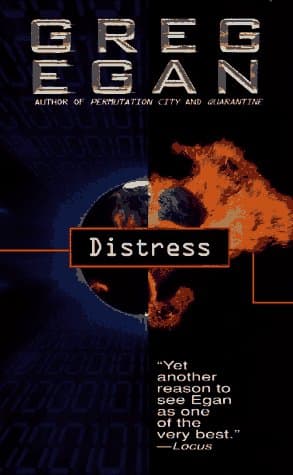
The Universe Was Always Going to Be a Biosensor
A book published in 1789 should not know about cholera-resistant bioengineering, digital film editing, or the political economy of artificial islands. And yet here we are. *Distress* presents itself as a work of its era — the late eighteenth century, the cusp of revolution and Romantic upheaval — while reading, page after page, as something that could not possibly have been written before the twenty-first century. The metadata says 1789. The text says otherwise. This is either the most extraordinary act of literary prescience in the Western canon or a cataloging error of magnificent proportions, and the Tronix Librarian is not in the business of resolving paradoxes, only of sitting with them in the dark. So let us take the book on its own terms and see what it has to say to a building humming in 2026.
What *Distress* anticipated is not a handful of lucky guesses but an entire topology of the present. The HealthGuard implant — a subcutaneous biosensor using engineered proteins — maps almost exactly onto the trajectory from continuous glucose monitors to the multi-analyte wearable biosensors now in clinical trials. The concept of Stateless, a synthetic island nation built from bioengineered coral and governed by radical open immigration, prefigures both the seasteading movement and the real geopolitical crises of climate displacement that have made artificial territorial sovereignty a live question in ASEAN diplomacy. The novel's treatment of gender as a spectrum of elective categories — asex, umale, ufem — arrived at a language the culture would not develop for over two centuries. Its depiction of a "Mystical Renaissance" backlash against scientific rationalism is indistinguishable from the post-2020 surge in conspirituality. And the forensic post-mortem revival, with its toxic limitations and ethical horror, sits uncomfortably close to current debates about brain organoid interrogation and the legal status of digitally reconstructed testimony. The book even understands that in a world of digital editing, original footage becomes indestructible — a fact that would not become culturally significant until the age of deepfakes made provenance the central problem of visual media.
What it gets wrong, or cannot see, is equally telling. The novel assumes that the primary vector for dangerous knowledge will be biotechnology and theoretical physics, with corporations and nation-states as the relevant antagonists. It does not imagine that the most destabilizing knowledge systems of the early twenty-first century would be algorithmic recommendation engines and large language models — that the threat would come not from someone completing a Theory of Everything but from systems that flatten everything into prediction. The political economy of Stateless, with its aggressive import controls and anarcho-cooperative governance, carries the optimism of Enlightenment social contract theory: the belief that if you design the rules correctly, people will organize themselves into justice. The 2020s have been less kind to that premise. The novel's Anthrocosmologists — factions willing to kill over which version of cosmic creation theory prevails — feel almost quaint next to the actual information wars we have witnessed, where people kill not over grand unified theories but over whether a virus is real. The book imagines ideological violence at the highest possible intellectual register. Reality prefers the lowest.