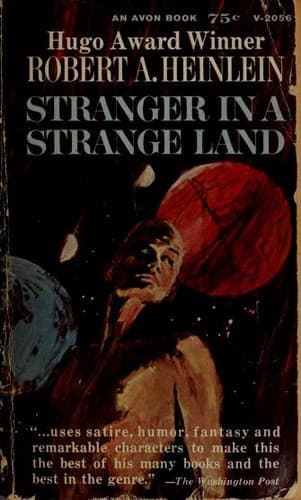
The Messiah Who Couldn't Grok the Internet
Heinlein set his story in the first decade of the twenty-first century and got the texture of that decade almost entirely wrong, which turns out to be the least interesting thing about where he was right. The political architecture — a Secretary General wielding consolidating power, media as both weapon and circus, the reflexive public hysteria around a figure who is simultaneously worshipped and threatened — reads less like prophecy and more like a recurring pattern Heinlein had the good sense to notice was permanent. The novel's depiction of a celebrity-messiah who accrues followers through charisma and sexual liberation while the establishment scrambles to contain him maps uncomfortably well onto the influencer-guru economy of the 2020s, from wellness cults to techno-utopian communes to whatever Elon Musk thinks he's doing on any given Tuesday. What Heinlein could not imagine — what no one in 1961 could — is that the medium of that cult-building would be algorithmic, disembodied, and conducted largely through screens. Mike Smith's Church of All Worlds spreads through physical presence, shared water, shared beds. The actual cults of our era spread through group chats and parasocial attachment. Heinlein understood the demand. He missed the supply chain.
The blind spots are large and well-documented, but they deserve restating because they are not incidental — they are structural. Heinlein's sexual revolution is a revolution authored entirely by male desire and narrated through male approval. Jill exists to be impressed, aroused, and educated. The women in Jubal's household exist to be decorative, competent, and sexually available, in that order. The novel's libertarianism extends to the bedroom but not to the question of who designed the bedroom. This was radical in 1961 in the same way that a man opening a door for you is radical if you've never seen a door. By 2026 it reads as a document of its era's most generous possible sexism — the kind that thinks it's liberating women by letting them be naked more often. The absence of any sustained interior life for the female characters is not a failure of craft; Heinlein could write complex people when he chose to. It is a failure of imagination dressed as philosophy.
What hits differently now is the religion. In 1961, the Church of All Worlds was satire with a utopian edge — Heinlein tweaking organized religion while sketching what a faith built on radical empathy and psychic communion might look like. In 2026, after Jonestown, Heaven's Gate, NXIVM, and the steady mainstreaming of charismatic authoritarian spirituality, Mike Smith's church reads as a case study in how cults actually form: a charismatic outsider with genuine abilities, a small circle of true believers who gatekeep access, escalating demands for intimacy as proof of loyalty, and the eventual violent confrontation with the outside world. Heinlein meant the mob killing Mike as an indictment of humanity's fear of the transcendent. Read now, it also functions as a warning about what happens when a community organizes itself around a single irreplaceable consciousness. The martyrdom feels less tragic and more inevitable — not because the world is cruel, but because the structure was always fragile.