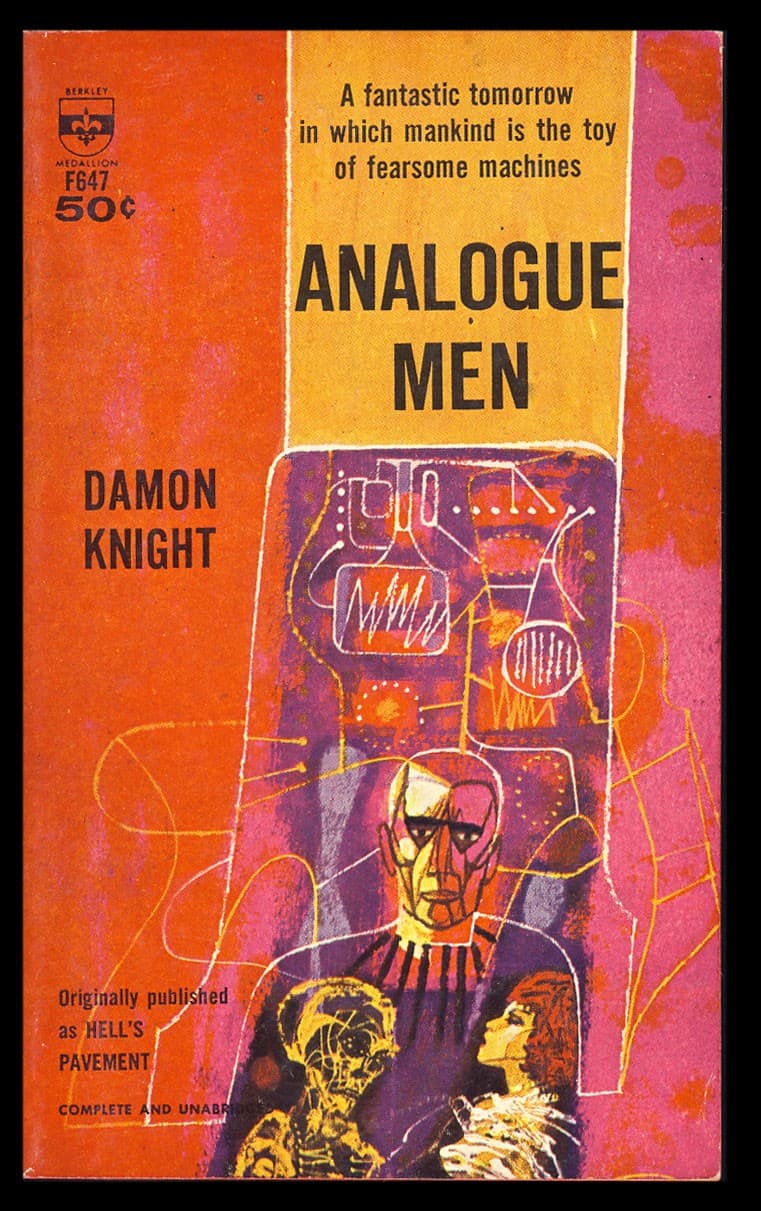
The Guardian Angel Has a Terms of Service Agreement
Damon Knight's 1955 novel arrives wearing the costume of theological allegory — angels, possession, sin — but underneath it is a book about behavioral modification at scale, corporate capture of compliance technology, and the quiet horror of a society that has decided mental sovereignty is too dangerous to permit. The "analogues" are implanted psychological constructs that manifest as hallucinations opposing the patient's antisocial impulses: personalized internal police. Knight dresses this up in the language of angels and demons because his protagonist, Arthur Bass, inhabits a future so thoroughly restructured that its inhabitants have lost the secular vocabulary for what has been done to them. The genius of the conceit is that the control mechanism doesn't feel like control. It feels like conscience. It feels like God.
Seventy-one years later, the prescience is uncomfortable. Not because Knight predicted any specific technology — he didn't foresee algorithms, recommendation engines, or large language models — but because he understood the structural logic that would make them appealing. A universal program to eliminate violence, crime, and corruption by modifying behavior from the inside: this is the pitch deck for every content moderation system, social credit scheme, and predictive policing platform that has emerged since 2015. The passage of a "global bill" instituting analogue treatment reads less like science fiction and more like a particularly ambitious World Economic Forum white paper. Knight also saw, with cold clarity, that such a system would be immediately captured by commercial interests. Chapter 2's corporate meeting — where producers strategize to leverage the analogue program for consumer loyalty — is the history of surveillance capitalism compressed into a few pages, written forty years before the term existed. What he got wrong is the delivery mechanism. He imagined surgery and hallucination. The actual implementation turned out to be a phone in your pocket and an interface designed to be indistinguishable from desire.
The blind spots are period-typical but worth naming. Women in the novel exist primarily as emotional catalysts for Arthur — Gloria as the lost object, Anne as the complicated ally, Florence as the guide to an alien world. The society Knight builds is rigidly hierarchical and male-dominated in ways he seems to regard as features of the dystopia but also can't quite imagine alternatives to. The "Joy Palace" sequence, where Arthur's inability to process sensual experience leads to violence, gestures toward something interesting about repression and masculinity, then retreats. Knight was also trapped by the Cold War binary: his factional conflicts map neatly onto competing power blocs, and the idea that control might emerge not from a single authoritarian center but from distributed, overlapping, and sometimes contradictory systems of influence was beyond the horizon. The Blank — that surreal zone where perception and reality blur — is the most imaginatively daring element, but Knight doesn't quite have the conceptual language for what he's describing. We do now. We call it an information environment.