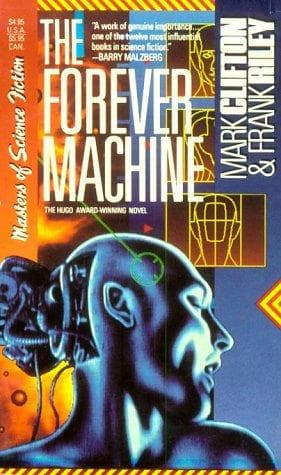
The Machine That Answered Everything Except the Point
Clifton and Riley wrote a novel about a synthetic brain that can solve any problem, provided you ask the right question. They set it in the 1990s. They published it in 1958. In 2026, we have machines that can generate plausible answers to nearly any question, and the central crisis is identical: nobody knows what the right questions are. Bossy — the novel's "forever machine" — is not a computer in any sense we would recognize. It is closer to an oracle, a system whose value depends entirely on the sophistication of its operators. This is not a bad description of a large language model. The novel's insistence that the bottleneck is human, not mechanical, lands with uncomfortable precision. What Clifton and Riley could not have foreseen is that the machines would learn to generate their own questions, and that this would make the human bottleneck not smaller but stranger.
The telepathy is where the book shows its age and, paradoxically, where it remains most interesting. Joe Carter's psychic surveillance of federal agents at a San Francisco train station reads like a fantasy of total information awareness dressed in parapsychological clothing. In 1958, telepathy was the genre's preferred metaphor for communication beyond institutional control — Bester had established this in *The Demolished Man* just a few years earlier. Clifton and Riley inherit the metaphor but push it toward something more like what we now call radical transparency: the idea that if everyone could see everyone else's intentions, coercion would become impossible, or at least visible. Social media did not deliver telepathy, but it did deliver a world in which surveillance is mutual, chaotic, and deeply unequal. The novel assumes telepathy would be clarifying. We have learned that total access to others' thoughts — or at least their utterances — is not clarifying at all. It is noise.
The political machinery of the book is its most dated element and also its most revealing. Kennedy — not the president, just a bureaucrat with ambitions — wants to control Bossy because controlling the machine means controlling the future. His strategy of promising Bossy to every faction while buying time for mass production is pure Cold War brinksmanship applied to technology policy. It assumes that the central tension around a transformative technology is *access*: who gets the machine, who doesn't. This was a reasonable assumption in 1958, when the atom bomb was the governing metaphor for dangerous knowledge. It is a less complete assumption now. The fights over AI in 2025 and 2026 are partly about access, yes, but more fundamentally about alignment, about what the machine optimizes for when nobody is asking it questions at all. Clifton and Riley imagined a world where the machine is passive, waiting. We got a world where the machine is generative, offering. The direction of the arrow flipped.