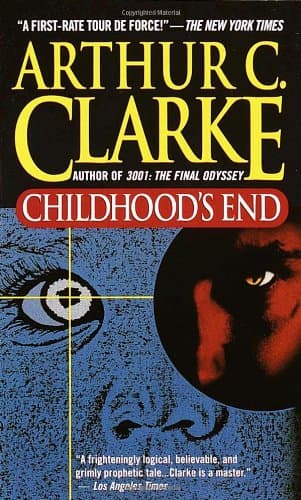
The Last Babysitter
Clarke wrote a novel about benevolent aliens who end the space race, abolish war, eliminate poverty, and gently steer humanity toward a golden age of leisure — then revealed that none of it mattered, because the species was always destined to dissolve into something unrecognizable. Published in 1953, *Childhood's End* reads in 2026 less like prophecy and more like a diagnostic of anxieties we still haven't resolved, dressed in a Cold War suit that fits worse every decade. The book's opening gambit — American and Soviet engineers racing to launch atomic-powered rockets, interrupted by vast alien ships — was already dated by 1969, when the actual moon landing happened without extraterrestrial interference. Clarke set his near-future in 1975 and got the geopolitics of the space race roughly right in spirit if not in detail. What he did not anticipate, and what no one in 1953 could have, is the degree to which the race would simply stop mattering. We went to the moon and then, for fifty years, mostly didn't go back. The Overlords weren't needed to ground us. We grounded ourselves.
What Clarke got right is more unsettling than his plot mechanics. The Golden Age under the Overlords — universal education, the collapse of organized religion under the weight of verifiable historical evidence, the replacement of meaningful work with entertainment and sport, a pervasive comfort that breeds a subtler despair — maps uncomfortably onto certain features of the 2020s. The death of ambition in a world of material sufficiency is not alien fiction anymore; it is a recurring theme in discussions of post-industrial economies, declining birth rates, and the so-called "meaning crisis." Clarke's humans, freed from want, turn to elaborate hobbies, cultural colonies, and televised spectacle. The New Athens colony, a deliberate effort to preserve creative vitality through social engineering, anticipates everything from intentional communities to the current discourse around screen time, algorithmic passivity, and the preservation of deep culture in an age of infinite content. He saw the shape of the problem. He just thought aliens would cause it.
The blind spots are period-typical and worth naming plainly. Women in *Childhood's End* are wives, mothers, and occasional fainters at séances. Jean Morrel's significance to the plot is literally biological — she is a vessel for the next evolutionary step, her consciousness secondary to her reproductive function. The global utopia Clarke imagines is curiously monocultural; the Overlords impose a single world government, and the novel treats this as a solved problem rather than the source of the deepest political conflicts of our actual century. There is no internet, no information warfare, no sense that the technologies of connection might themselves become the crisis. Clarke's future has flying cars and deep-sea laboratories but no social media, no algorithmic radicalization, no sense that the tools of leisure might atomize rather than unite. The Overlords' great reveal — a device that lets humanity view the past, demolishing religious faith overnight — assumes that evidence settles belief. That assumption has aged worse than anything else in the book.