The Loneliest Engineering Problem
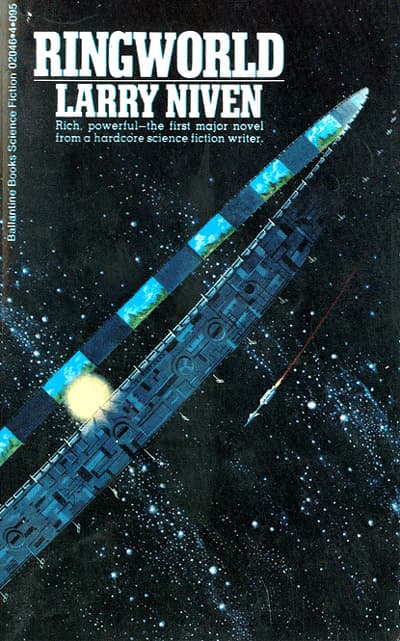
Ringworld is a novel about scale that has trouble with people. This was true in 1970, and fifty-six years have only sharpened the disparity. Larry Niven built one of science fiction's most enduring megastructures — a band of habitable real estate with three million times Earth's surface area, orbiting a sun at a comfortable distance, spinning for gravity — and then populated it with a cast whose inner lives fit comfortably on a napkin. The engineering holds up remarkably well. The sociology does not. Louis Wu's two-hundredth birthday party, his casual globe-trotting through transfer booths, the homogenization of Earth's cultures into a pleasant beige — Niven saw the flattening effect of frictionless connectivity before anyone had heard of the internet, let alone doomscrolled through an airport. The transfer booths are not the internet, but they produce the same spiritual malaise: everywhere is the same place, and novelty requires increasingly extreme distances. That Louis Wu is bored at two hundred, restless and sensation-seeking, feels less like far-future speculation now and more like a clinical description of anyone with a smartphone and a passport.
What Niven anticipated about infrastructure is sharp; what he missed about society is almost poignant. The Birthright Lottery — humanity breeding for luck through Teela Brown's lineage — reads today less as speculative genetics and more as a clumsy parable about survivorship bias, the kind of thinking that Silicon Valley venture capitalists apply to portfolio theory. The idea that luck might be a heritable, selectable trait is treated with a straight face that now seems quaint, given what we actually know about polygenic traits, epistasis, and the sheer computational intractability of breeding for anything as diffuse as "fortune." Meanwhile, the novel's gender politics have aged like milk left on a Ringworld sunflower field. Teela Brown exists to be young, beautiful, lucky, and in need of protection. Prill exists to seduce and be conditioned. The women are instruments — of plot, of luck, of sexual availability — and the narrative never pauses to notice. This was a blind spot in 1970. It is a crater now.
The book's real prescience lies elsewhere: in its treatment of civilizational collapse as a consequence of technological dependency. The Ringworld's inhabitants have fallen into barbarism not because of war or plague but because a single critical technology — the "cziltang brone," the device permitting passage through the rim wall — broke, and nobody remembered how to fix it. The ramship crews, the engineers, the knowledge class: all gone or degraded. What remains is cargo-cult religion, worship of the Ringworld Engineers as gods, and a population that lives on the surface of a miracle it cannot comprehend. In 2026, with global supply chains still fragile from successive shocks, with chip fabrication concentrated in a handful of facilities, with the average person unable to explain how their phone works let alone repair it, this is not allegory. It is a diagram. Niven, who was primarily interested in the physics of the ring, accidentally wrote one of the most durable parables about the fragility of complex systems. The fact that he didn't seem to realize he was doing it makes it more convincing, not less.