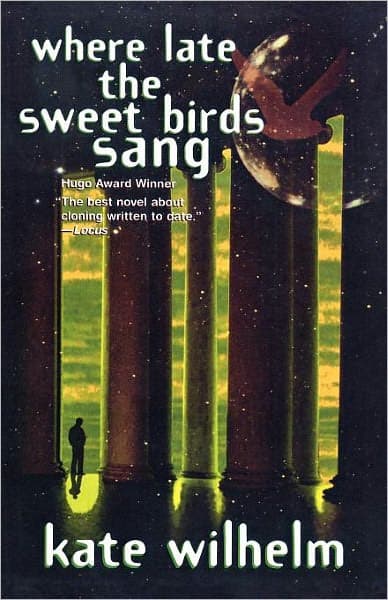
The Valley That Ate Its Children
Kate Wilhelm wrote a novel about cloning in 1976 and got almost everything wrong about the science and almost everything right about the sociology. The Sumner family, retreating to their Appalachian valley as the world collapses around them, turns to reproductive technology not out of ambition but desperation — and then watches as the technology turns on them, producing generations that are technically human but experientially alien. Wilhelm didn't anticipate CRISPR, didn't foresee mitochondrial replacement therapy or the bizarre reality of cloned pets, couldn't have imagined that by 2025 we'd be debating the ethics of synthetic embryos grown without sperm or egg. Her cloning is vat-grown and hand-waved, a plot device more than a technology. But what she nailed — with uncomfortable precision — is the way a community under existential pressure will surrender individual autonomy to collective survival, and then discover it cannot get that autonomy back. The clone-groups' hive-minded conformity, their inability to function alone in wilderness, their reflexive punishment of anyone who demonstrates creative independence: this reads less like science fiction now and more like a clinical description of algorithmic social sorting. The children raised in pods who cannot tolerate solitude are not so far from children raised in feeds who cannot tolerate boredom.
The book's blind spots are period-typical and worth naming. Wilhelm's ecological collapse is a 1970s cocktail — pollution, radiation, famine — stirred with the specific anxieties of the post-Silent Spring, post-oil-embargo moment. Climate change as we understand it is absent. So is any meaningful engagement with race; the Sumner valley is implicitly white, its insularity never examined as a choice with racial dimensions, which in an Appalachian setting is a significant omission. The gender politics are more interesting than they first appear — Molly's arc as a breeder stripped of agency and drugged into compliance is genuinely harrowing — but the novel still treats fertile women primarily as vessels, a framing it critiques without fully escaping. And the resolution, such as it is, places its hope in a single exceptional male child, Mark, whose rugged individualism will supposedly restart human evolution. This is a very American salvation narrative. It trusts the lone genius more than it should.
What hits differently now is the middle section — Molly's story. In 1976, her chapters functioned as a bridge between David's founding tragedy and Mark's heroic rebellion. In 2026, they are the book's center of gravity. A woman whose artistic impulse is pathologized by her community, who is chemically suppressed and physically confined because her interiority threatens collective stability, who has her child taken from her and her memories erased — this is not speculative anymore. It is a recognizable pattern. The Ceremony for the Lost, the community's ritual for disposing of individuals who develop too much selfhood, could be a euphemism from any number of contemporary institutional contexts. Wilhelm understood something that René Dubos articulated in *So Human an Animal* but couldn't dramatize: that the reduction of a person to their biological function is itself a form of extinction, even if the body survives.