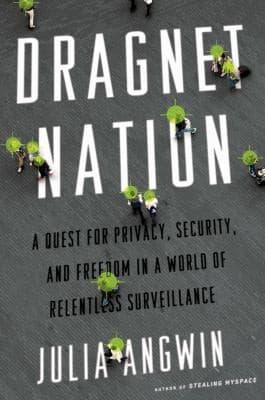
The Woman Who Brought a Knife to a Drone Fight
Julia Angwin spent a year trying to escape the surveillance apparatus of 2013, and the most useful thing about reading her account in 2026 is the precise measurement it offers of how quaint our fears once were. She worried about Google retaining search queries. She fretted over tracking cookies. She obtained a burner phone and felt like a spy. She created a fake identity named Ida Tarbell — after the muckraker, naturally — and tried to get a credit card for her. These were reasonable, even admirable gestures in their moment. They now read like someone installing a deadbolt while the walls of the house are being carted away by crane. What Angwin documented with genuine rigor was the infrastructure of a surveillance economy still in its adolescence. The third-party doctrine, the post-9/11 legal architecture, the data broker ecosystem, the complicity of tech companies served with National Security Letters — all of this was laid out with a journalist's specificity and a citizen's alarm. She was right about nearly all of it. She was right the way someone standing on train tracks is right that a train is coming, while underestimating its speed by an order of magnitude.
What Angwin anticipated with impressive clarity was the normalization problem: that people would simply accept pervasive data collection as a cost of participation in modern life. Her comparison of data exploitation to environmental pollution — a tragedy of the commons eroding public trust — has proven more apt than she likely imagined. The EU's General Data Protection Regulation arrived four years after publication, and the California Consumer Privacy Act two years after that, both echoing her framework. But the deeper prescience lies in her chapter on children's surveillance, where she identified the fundamental tension between parental monitoring and childhood autonomy. She could not have foreseen TikTok's algorithmic capture of adolescent attention, the explosion of school-issued device monitoring software during the pandemic, or the degree to which children's biometric data would become a commodity. She saw the trajectory. She did not see the acceleration. Her discussion of facial recognition as an emerging concern now reads as a dispatch from before the flood — before Clearview AI scraped billions of faces, before real-time identification became municipal infrastructure, before the technology was deployed against protesters in ways that would have confirmed her darkest analogies to the Stasi.