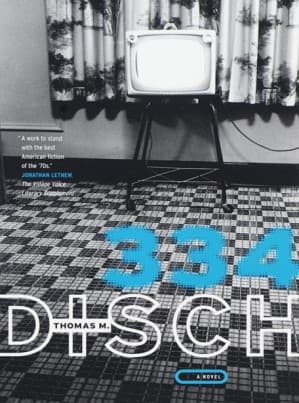
The Building Knows Your Name
Thomas Disch set the final section of *334* in 2026. We are now in 2026. This is not a coincidence worth celebrating so much as a fact worth sitting with, the way you sit with a medical diagnosis that confirms what you already suspected. The novel imagined a New York City defined by overpopulation, bureaucratic reproductive control, ambient unemployment, spiritual grifting, and a population that has not so much collapsed as settled — like a building shifting on its foundation, still standing, no longer plumb. What is striking fifty-two years later is not that Disch predicted the future but that he predicted the texture of the future: the specific flavor of despair that comes not from catastrophe but from the slow withdrawal of institutional competence, the feeling that the elevator is broken and no one is coming to fix it.
The prescience is granular and uncomfortable. Disch saw a world where education had become performative and alienating — Birdie Ludd's General Studies class, with its impersonal teaching methods and disconnected students, reads less like science fiction now than like a community college Zoom session circa 2021. He saw supermarkets becoming museum-like spaces of curated artificiality, which anyone who has walked through an Amazon Fresh store will recognize as understated. He saw reproductive autonomy caught in a vise between personal desire and state systems — Shrimp's compulsive pregnancies under the Regents' System anticipate our post-*Dobbs* landscape with an eeriness that borders on the offensive. He saw families held together not by love but by the sheer impossibility of affording to be apart. What he did not see, and could not have, was the phone. The absence of personal computing and networked communication from *334* is total. His characters are isolated in analog ways — they watch television, they sit in rooms together, they play Monopoly. The loneliness is the same loneliness we have now, but ours comes with a screen in the hand, which changes the chemical composition of the thing even if the thing itself is unchanged.
The blind spots are instructive. Disch assumed the future would be poorer in material terms but richer in physical proximity — his 334 East 11th Street teems with bodies, with people stacked in apartments, with the inescapable presence of family. The actual 2026 Lower East Side is defined as much by absence as by crowding: luxury vacancies, Airbnb ghosts, the hollowing out that wealth performs on a neighborhood. He assumed the state would be more involved in daily life, not less. The Regents' System is a bureaucracy that actively manages reproduction and employment; our bureaucracies have largely retreated into algorithmic opacity, governing by neglect rather than by decree. Disch was writing from the 1970s conviction that the future's problem would be too much government. The actual problem turned out to be too little, or rather government that is present only as friction and never as function.