The Prophecy That Underestimated Its Own Subject
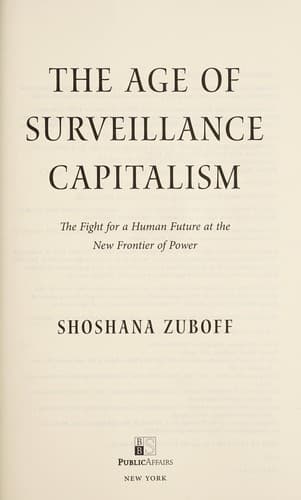
Shoshana Zuboff's 2019 treatise arrived with the force of a naming ceremony. Before this book, the practices it describes were diffuse, half-understood, discussed in fragments across privacy forums and academic papers. Zuboff gave the thing a name — surveillance capitalism — and in doing so gave millions of people a way to articulate a discomfort they had been carrying in their bodies like a low hum. The book's central argument is by now well-rehearsed: that companies like Google and Facebook discovered they could extract human experience as raw material, refine it into behavioral predictions, and sell those predictions in markets that trade on the certainty of human action. What made the book formidable was not the novelty of each individual observation but the architecture Zuboff built around them — the insistence that this was not a glitch in capitalism but a mutation of it, a new logic with its own laws of motion. Seven years later, the architecture holds. The building she described is still standing. But several new wings have been added that she did not draw.
What Zuboff got right is by now almost too easy to catalog. The colonization of domestic life through smart devices has proceeded exactly as she warned, with Alexa, Ring, and their descendants settling into homes as ambient listeners whose terms of service no one reads. Her concept of "rendition" — the unilateral claiming of private experience as free raw material — anticipated the explosion of generative AI training on scraped human output with unsettling accuracy, even though she could not have named the specific mechanism. The "prediction imperative" she identified has only intensified: recommendation engines, dynamic pricing, and behavioral nudging are now so normalized they barely register as interventions. Her framework of "instrumentarian power" — a mode of control that doesn't need violence, only behavioral certainty — reads now less like theory and more like product documentation. The social media hive mind she described in Part III, with its group pressure replacing democratic deliberation, is the daily weather report of platforms like X, TikTok, and their successors.
And yet the book has blind spots that have widened with time. Zuboff's framework is relentlessly focused on the corporate extraction of behavioral surplus, which led her to underestimate the degree to which states — not just intelligence agencies in quiet partnership with Silicon Valley, but sovereign governments acting openly — would become primary architects of surveillance infrastructure. China's social credit experiments were mentioned but treated as a distant cautionary tale; by 2026 the interpenetration of state and corporate surveillance is the norm in dozens of countries, including liberal democracies deploying facial recognition and predictive policing with minimal public debate. She also could not have anticipated how quickly the political economy of AI would shift the center of gravity from behavioral advertising to foundation models, where the extraction is not just of behavioral data but of the entire recorded output of human culture — text, image, voice, code — fed into systems whose owners claim the derivative products as their own. Surveillance capitalism, it turns out, was a precursor to something she didn't quite name: extraction capitalism applied to cognition itself. Her analysis also remains curiously silent on labor — on the content moderators, data labelers, and gig workers whose underpaid work sustains the very systems she critiques. The humans inside the machine are largely absent from her account of the machine's victims.