The Empathy Trap
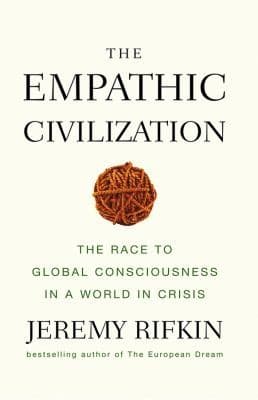
Jeremy Rifkin's *Empathic Civilization* arrived in 2009 with the confidence of a man who believed he had found the master key to human history. The thesis is bold and architecturally simple: empathy expands in lockstep with energy regimes and communication technologies, binding ever-larger circles of humanity into shared feeling — first kin, then tribe, then nation, then species. The catch, and Rifkin knows it's a catch, is that each expansion of empathic consciousness requires a corresponding increase in energy throughput, which accelerates environmental entropy. The race, then, is whether we can achieve "biosphere consciousness" before the biosphere collapses under the weight of the very infrastructure that made such consciousness possible. In 2009 this had the ring of a prophetic paradox. In 2026 it reads more like a clinical description of the trap we're sitting in, except the trap turned out to have dimensions Rifkin never mapped.
What he got right, and substantially so, was the architecture of distributed networks as a social and economic force. Chapter 13's vision of "distributed capitalism" — decentralized, collaborative, enabled by grassroots computing — anticipated the logic of blockchain economies, mutual aid networks that scaled during COVID-19, and the platform cooperativism movement that has gained traction in the last five years. His insistence that GDP was an inadequate measure of civilizational health now sounds less like heterodox economics and more like a policy consensus slowly forming around well-being indices. The chapter on parasocial relationships and global emotional events — Princess Diana's death, the 2004 tsunami — was genuinely prescient about the mechanics of collective digital grief, a phenomenon that has since become almost routine, from viral mourning rituals to the real-time emotional processing of climate disasters on social media. Rifkin understood that the infrastructure of feeling was being rebuilt, and he understood it early.
But the book's blind spots are severe, and they are the blind spots of 2009 liberalism at its most optimistic. Rifkin assumed that expanding connectivity would expand empathy more or less monotonically. He did not foresee — or could not bring himself to name — the possibility that the same communication technologies could be weaponized to *contract* empathic circles, to sort humans into algorithmically reinforced tribes more efficiently than any prior technology. The rise of authoritarian populism, coordinated disinformation, and AI-generated synthetic media has demonstrated that the relationship between connectivity and empathy is not linear but volatile. His treatment of "biosphere consciousness" as an emergent inevitability of networked life looks painfully naive after a decade in which climate denial was industrialized and exported through the very platforms he celebrated. The book contains no serious reckoning with the possibility that empathy itself might be commodified, performed, and depleted — that compassion fatigue is not a bug in the system but a structural feature of the attention economy. The theatrical self he describes in Chapter 14, drawing on Goffman and Stanislavski, now reads less like a liberating improvisational identity and more like the exhausting labor of personal branding on platforms designed to extract engagement from emotional display.