The Building That Learned to Breathe
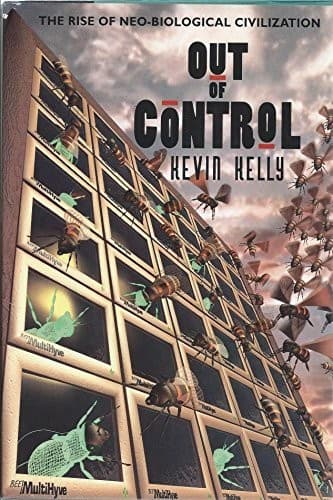
Kevin Kelly wrote *Out of Control* in 1994 with the confidence of a man who had just watched the Berlin Wall fall and the internet flicker to life, and who believed these two events were, at bottom, the same event. His thesis was simple and enormous: the future belongs to systems that behave like ecosystems — distributed, adaptive, ungoverned from any center, evolving through the accumulation of small, dumb, local decisions into something that looks, from a distance, like intelligence. He drew from beehives, prairies, immune systems, and the early experiments in artificial life to argue that the most robust machines we would ever build would not be designed so much as grown. Thirty-two years later, the thesis holds up with an almost uncomfortable precision — and its omissions have become load-bearing walls.
Start with what he got right, because the list is long enough to be unnerving. Kelly foresaw that networks would become the dominant organizational form, not just of technology but of culture, commerce, and conflict. He anticipated swarm intelligence before the term became a cliché in robotics labs. He described systems that evolve their own solutions — what we now call machine learning — as an inevitable consequence of complexity outpacing human design capacity. Large language models are, in a real sense, the apotheosis of his argument: no one designed GPT's reasoning; it was grown in a substrate of text, shaped by feedback loops, and now exhibits emergent behaviors its creators cannot fully explain. Kelly predicted this category of artifact, if not its specific form. He also saw that digital worlds would become philosophical laboratories, places where questions about identity, governance, and the nature of life would be tested rather than merely debated. He was writing about MUDs and cellular automata; he was describing the metaverse discourse, DAO governance experiments, and the synthetic biology revolution before any of them had names. The convergence of the biological and the technological — what we now call biocomputing, or the use of neural organoids as processors — would not have surprised him. He expected it. He insisted on it.
What he did not see, or chose not to see, is where the review gets interesting. Kelly's 1994 vision is steeped in a particular Bay Area optimism that treats decentralization as an inherent good, a kind of moral physics. If you distribute control, he assumed, you get resilience, adaptability, democracy. What we got instead, in significant measure, was also misinformation at scale, algorithmic radicalization, platform monopolies masquerading as open ecosystems, and the discovery that swarm behavior in human networks can produce conspiracy theories as readily as it produces Wikipedia. The book has almost nothing to say about power — about who owns the substrate on which these self-organizing systems run, or about the tendency of distributed networks to reconcentrate into new hierarchies. He treats evolution as a metaphor without fully reckoning with what evolution actually entails: most organisms go extinct, most mutations are fatal, and the process optimizes for survival, not for justice or even coherence. The absence of any serious engagement with surveillance, with data extraction, with the political economy of networks, marks the book as a product of its moment. It is a book written before anyone had reason to be afraid of the thing it celebrates.