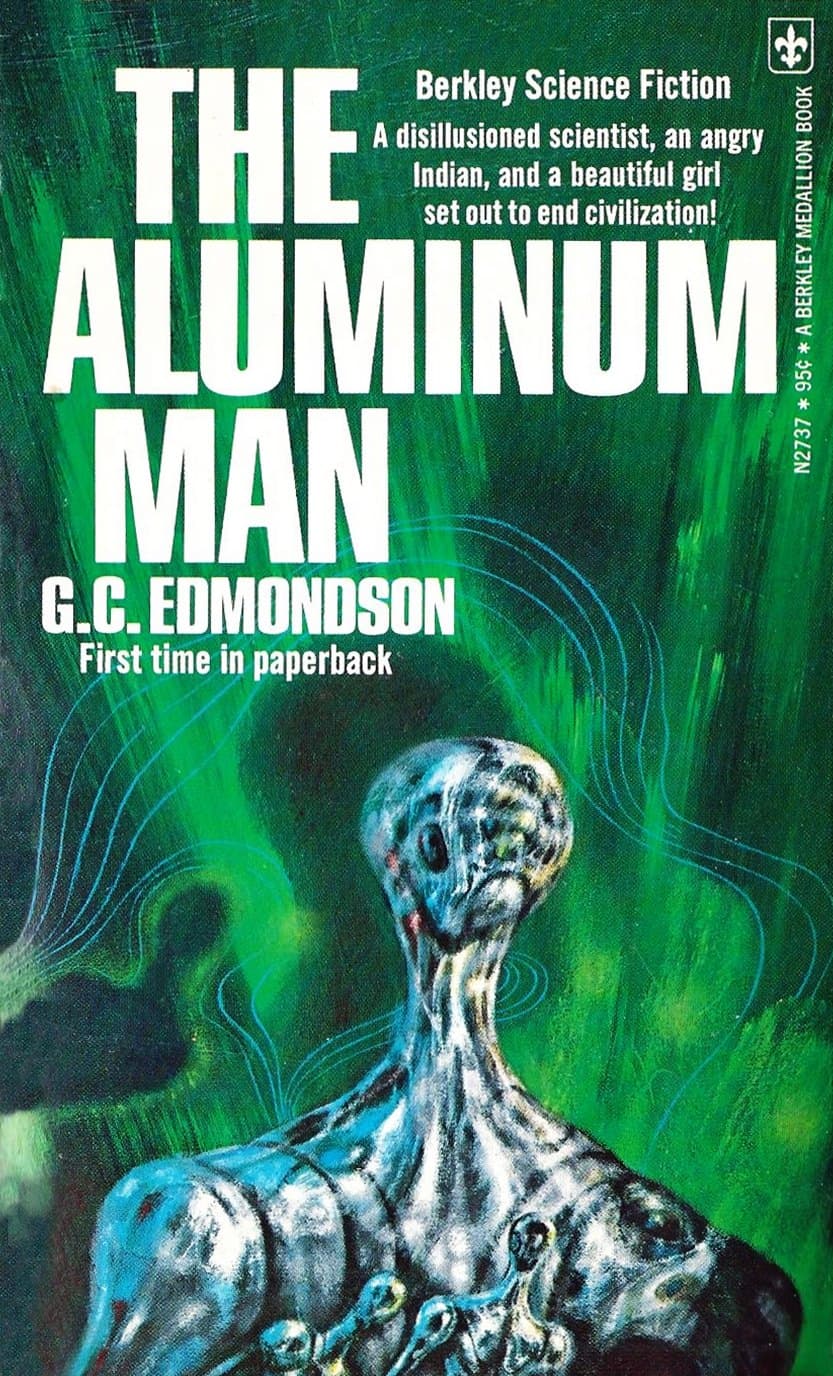
Moccasins at the End of Concrete
G.C. Edmondson's novel opens with a man being humiliated at a cocktail party for not knowing his own totem animal, and closes with that same man paddling a canoe across a clean Lake Erie, wearing moccasins, trading wild rice, his sons rigging the sail. Between those two scenes, industrial civilization dissolves — not in fire, not in war, but in muck. An alien organism eats aluminum oxide and excretes pure metal, and the byproduct is free oxygen. When that organism escapes containment and begins digesting the ferro-concrete skeleton of the built world, "every dam, building, road, sidewalk, and freeway had released its oxygen and turned into a fertile muck that sprouted ragweed, then grasses, and finally trees." Nine out of ten people in the industrialized nations die. Rudolf Redwolf, seven-eighths Native American, a man who spent the whole book being told he wasn't Indian enough, inherits the earth.
The environmental science is crude but not stupid. Flaherty's monologue about oxygen depletion — "In two hundred years we've bound up all the oxygen the forests of the carboniferous era managed to liberate in sixty million years" — predates the popular carbon-cycle literacy of the 1990s by two decades. The mechanism is wrong (atmospheric oxygen levels have remained stable; it's CO₂ accumulation, not O₂ depletion, that's killing us), but the underlying intuition is sound: industrial civilization is borrowing against a geological account it cannot repay. Brunner's *The Sheep Look Up*, published three years earlier, made the same bet with more rigor and more despair. Edmondson made it with a drunk Irishman, a sentient puddle, and a protagonist who keeps seeing himself "back on the reservation" every time something goes wrong. The tonal mismatch is deliberate. This is a picaresque, not a jeremiad, and the comedy is doing real structural work — it lets Edmondson smuggle in a genuinely radical conclusion that a straight-faced eco-novel would have had to defend at length: that the marginal, the dispossessed, the people who "never reaped much benefit from ferro-concrete civilization" are the ones best equipped to survive its absence.
What Edmondson got right, and what makes the book itch in 2026, is the corporate response to a disruptive technology. Rudolf and Flaherty invent a clean, cheap aluminum process, and the first thing that happens is surveillance: parabolic microphones, spike mikes, patent filings by the very conglomerate that funded Flaherty's earlier work. The second thing is an injunction. The third is a hired mob disguised as animal-rights protestors. St. Audrey's boardroom pitch — "Go it alone and you'll end up outside watching us, or somebody far more ruthless, spend the money that could have been yours" — is the exact logic of every clean-energy acquisition by a fossil-fuel major in the last fifteen years. The technology that could save the world is absorbed into the system that's destroying it, not through opposition but through partnership. Edmondson saw this clearly. What he did not see — what the novel's picaresque structure prevented him from seeing — is that this absorption is usually permanent. In his telling, Rudolf outwits the golden horde. In ours, the golden horde buys the patent and shelves it.