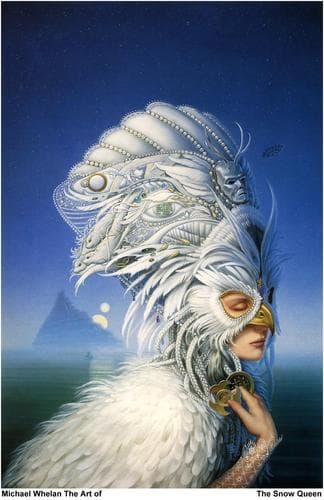
The Song the System Sings When No One Is Listening
Joan D. Vinge published *The Summer Queen* in 1991, the year the Soviet Union dissolved, the year the World Wide Web went public, the year we collectively decided that history had ended and the future would be administered by sensible technocrats. Into that moment she delivered an 800-page novel about a woman trying to govern a planet caught between indigenous ecological knowledge and the extractive logic of an interstellar hegemony—a novel in which the most important technology is not a weapon or a starship but a distributed biological network that links minds across space, and in which the central crisis is whether a civilization can be rebuilt without repeating the environmental sins that collapsed the last one. The book was not reviewed widely. It sold modestly. It is, thirty-five years later, one of the most quietly prescient science fiction novels of its decade, and its prescience is of the uncomfortable kind: it anticipated not specific gadgets but specific failures of will.
Start with the sibyl network. Vinge imagined a technoviral system—part biological, part informational—that connects human minds into a shared knowledge base accessible through trance states. In 1991 this read as mysticism dressed in science fiction clothes. In 2026 it reads as a remarkably early sketch of networked intelligence, of what happens when knowledge becomes ambient and access to it becomes a political question rather than a technical one. The sibyls are not the internet, but they prefigure the central tension of our information age: who gets to query the system, who maintains it, and what happens when the system's own integrity degrades because no one understands the infrastructure anymore. That last point lands hard. Vinge's plot hinges on the discovery that the sibyl mind—the vast computational substrate underlying the network—is failing because its biological maintenance system, the mers, has been hunted nearly to extinction for a luxury commodity. The analogy to our own collapsing biospheres, strip-mined for short-term profit by actors who don't understand or don't care what ecological functions they're destroying, was pointed in 1991. In 2026, after coral bleaching events, insect population crashes, and the dawning realization that we have been systematically dismantling planetary systems whose complexity we barely comprehend, it is no longer pointed. It is descriptive.
What the book gets wrong, or rather what it cannot imagine, is the sheer velocity of informational chaos. Vinge's Hegemony is bureaucratic, slow, hierarchical—a galactic empire modeled on the declining British Raj or perhaps the late Habsburg administration. Power moves through committees and police inspectors and trade agreements. There is no equivalent of viral misinformation, no algorithmic radicalization, no sense that the information network itself might be weaponized not by elites but by the network's own emergent dynamics. The sibyl mind can be damaged by neglect, but it cannot lie. This is the book's most dated assumption: that the primary threat to a knowledge system is ignorance or suppression rather than pollution. Vinge also inherits from her era a faith in the exceptional individual—Moon Dawntreader, BZ Gundhalinu, Reede Kullervo—as the lever by which systems are moved. The narrative grammar is heroic even when the politics are systemic. This is not a flaw exactly, but it is a signature of its time, the last decade in which American science fiction could unselfconsciously believe that the right person in the right place could redirect the course of civilizations. We are less sure of that now.