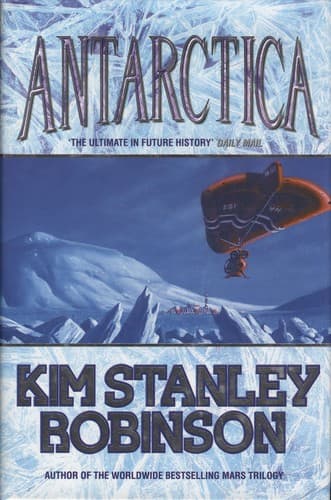
The Building That Hums at the Bottom of the World
Robinson wrote this novel in the late nineties, when Antarctica was still mostly a subject for heroic expedition narratives and nature documentaries. What he produced instead was a book about labor. About the experience of being a contractor in a place that doesn't want you, doing work whose purpose you only half-understand, for an institutional apparatus that regards you as replaceable. X is not an explorer. He is a General Field Assistant — a title so deliberately unglamorous it functions as a kind of joke the continent plays on everyone who comes there looking for meaning. The fact that Robinson centered this story on a GFA rather than a scientist or an adventurer was, in 1998, a quiet act of genre defiance. In 2026, it reads as something closer to prophecy. The gig-ification of extreme environments is no longer speculative. McMurdo Station's support staff have always been a mix of idealists and drifters, but the broader pattern Robinson traced — skilled workers deployed to hostile frontiers under precarious institutional arrangements, falling in love with places they have no claim to — now describes everything from Arctic mining camps to the technician corps servicing remote renewable energy installations. He saw the emotional architecture of precarious work before most novelists noticed it existed.
What Robinson got right about the climate conversation is less about specific projections and more about tone. He understood, earlier than most, that the discourse around Antarctica would shift from preservation-as-abstraction to preservation-as-geopolitics. The Antarctic Treaty System, which he treats in the novel as both fragile and sacred, has in the intervening decades come under exactly the kind of pressure he anticipated — not from outright violation but from the slow erosion of consensus, the quiet repositioning of national interests under scientific cover. China's expanding base infrastructure, Russia's periodic treaty-testing, the creeping resource calculus as ice sheets destabilize: Robinson didn't predict the specifics, but he nailed the vector. Where he was less accurate, or perhaps simply less interested, was in imagining the speed and scale of ice loss itself. The novel treats Antarctic warming as a slow crisis, a matter for policy debate. The reality of Thwaites Glacier's accelerating instability, the revised sea-level projections, the sheer panic in glaciology circles — these would have given the book a different pulse entirely. Robinson's Antarctica is threatened. The real Antarctica is hemorrhaging.