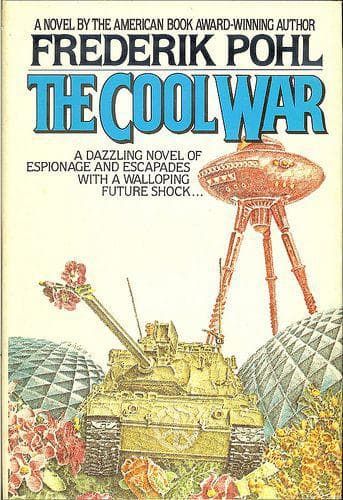
The Saboteurs Who Couldn't Afford the Lights
Pohl's 1980 novel opens with a world that runs on rationed energy, petty covert operations between nations, and a pervasive sense that civilization is too exhausted to wage real war but too spiteful to stop fighting. The "cool war" of the title is not cold — it's lukewarm, fought through engineered viruses, infrastructure sabotage, economic manipulation, and the deliberate spread of agricultural pests. No mushroom clouds. Just a slow, grinding degradation of everything, carried out by bureaucratic teams whose agents are ministers and drifters rather than James Bonds. Reading this in 2026, the premise no longer reads as speculative. It reads as a status report. The SolarWinds hack, Stuxnet, the suspected sabotage of Nord Stream pipelines, Chinese salt typhoon intrusions into American telecom infrastructure, Russian troll farms, the weaponization of supply chains — Pohl didn't predict the specifics, but he nailed the grammar of 21st-century conflict. War without declaration. Damage without attribution. Escalation without acknowledgment. The novel's central insight — that nations could be locked in perpetual, deniable hostility while their citizens mostly just noticed that things kept getting worse — is no longer science fiction. It's the news cycle.
What Pohl got most right was the texture of decline. His America doesn't collapse; it frays. Hydrogen-powered cars exist but get sabotaged. Churches double as community centers because nothing else is funded. Power rationing is a fact of life. Crime is ambient. The environment is degraded not by one catastrophe but by a thousand small ones, many of them deliberately inflicted by rival nations. This is not the gleaming dystopia of Orwell or the ash-heap of post-nuclear fiction. It's something more banal and therefore more accurate: a society that can still function but has forgotten what functioning well felt like. The parallel to the 2020s — where infrastructure crumbles, housing costs devour wages, and the phrase "managed decline" has entered common usage in multiple Western democracies — is uncomfortable. Pohl understood that the future wouldn't arrive as a rupture. It would arrive as erosion.
The blind spots are where you'd expect them. Pohl's 1980 lens couldn't conceive of the internet, social media, or the information dimension of conflict — which is precisely the domain where the "cool war" has been most aggressively waged in reality. His covert agents travel by bus and train, make phone calls, and look things up in directories. The absence of networked information warfare is the book's largest structural gap; a 2026 version of this story would be unrecognizable without it. His gender politics, while not egregious for the era, are dated — Leota and Alys orbit Hake's decisions more than they shape events. And his geopolitics, centered on a vaguely Middle Eastern petro-state and a declining America, misses the rise of China entirely, a lacuna shared by nearly every Western futurist of the period. The hydrogen economy he posits never materialized at the consumer level, though it's now closer than it was in 2000. He was early, not wrong.