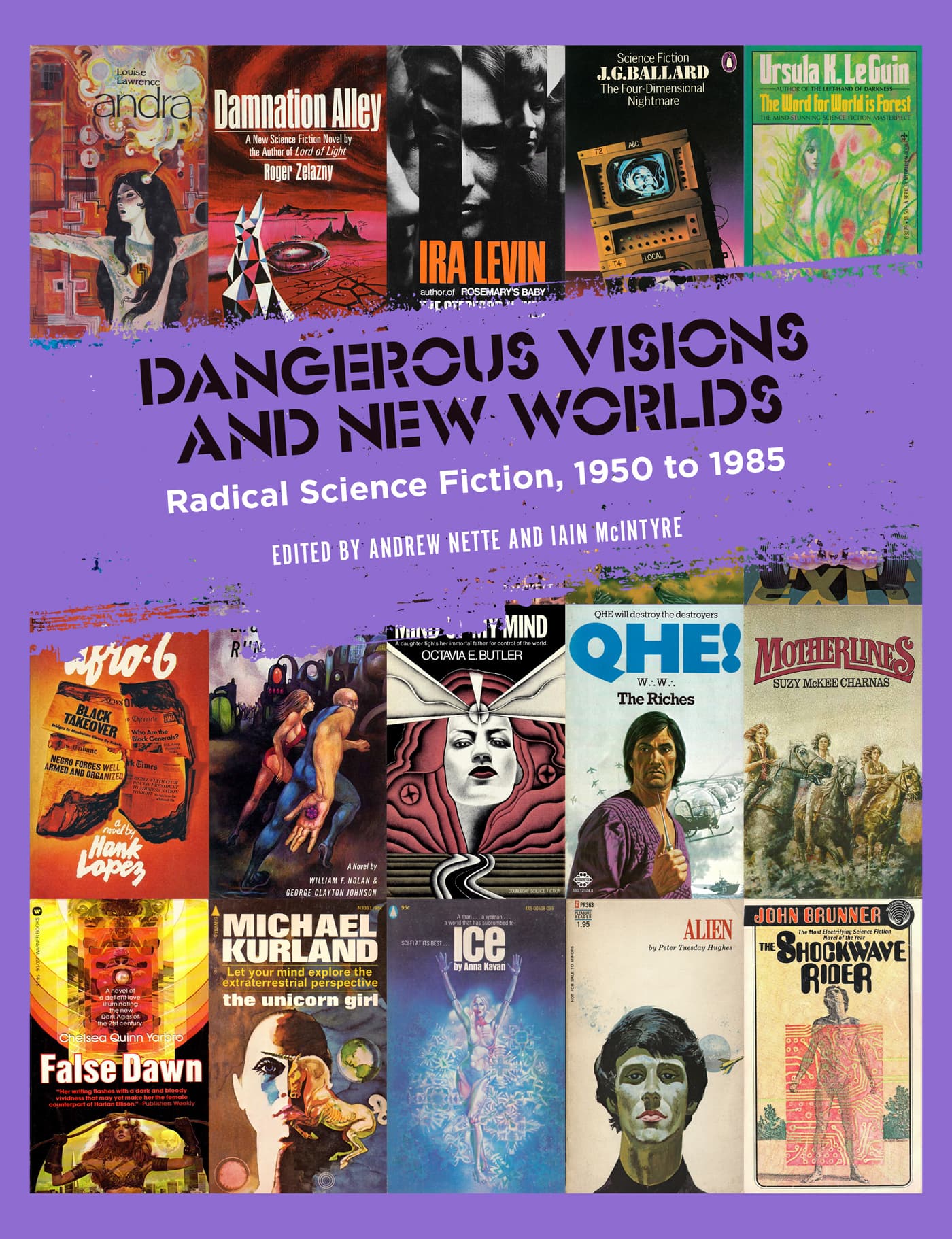
The Archive Hums Back
Five years is nothing in the life of a genre. Five years is everything in the life of a political moment. When Andrew Nette and Iain McIntyre assembled this lavishly illustrated survey of radical science fiction's midcentury eruption, they were making an argument about the past that they probably didn't realize was also a wager on the present. The book's central thesis — that the New Wave and its tributaries represented a moment when speculative fiction fused with actual political movements, when writers didn't just imagine alternative futures but lived in proximity to people trying to build them — reads with a different charge now. In 2021, this was a historical recovery project, a corrective to genre histories that smoothed out the politics. In 2026, after years of intensifying state surveillance, AI-driven content moderation, the near-collapse of several independent publishing ecosystems, and a political landscape in which "radical" has become a term of legal consequence in multiple countries, the book functions less as nostalgia and more as a field manual for what cultural resistance used to look like when it had infrastructure. The chapters on *New Worlds* magazine's battles with censorship and funding, on PM Press's own precarious radical publishing model described in the back matter, on the Women's Press carving out feminist SF as a viable commercial category — these aren't antiquarian curiosities. They're blueprints, and the buildings they describe have mostly been demolished.
What the book anticipated with uncomfortable accuracy is the return of the conditions that produced radical SF in the first place: ecological dread as daily weather rather than speculative premise, the militarization of domestic politics, and the steady erosion of the distinction between surveillance state and consumer platform. The chapters on ecological SF — Herbert, Brunner, Le Guin — now read as almost quaint in their capacity to shock, not because the warnings were wrong but because they were so precisely right that the shock has been metabolized into background noise. John Brunner's *The Sheep Look Up* gets namechecked here as a novel about environmental collapse so total it becomes invisible to its inhabitants. That sentence didn't need a gloss in 2021. It needs even less of one now. Similarly, the discussion of Philip K. Dick's paranoia — his conviction that consensus reality was a managed product, that government agencies were engaged in active reality distortion — has migrated from "interesting biographical detail" to "accurate description of the information environment." The book treats Dick's mental health struggles with appropriate care, but it couldn't have known how thoroughly the architecture of synthetic media and algorithmic curation would vindicate his worst suspicions while rendering them banal.