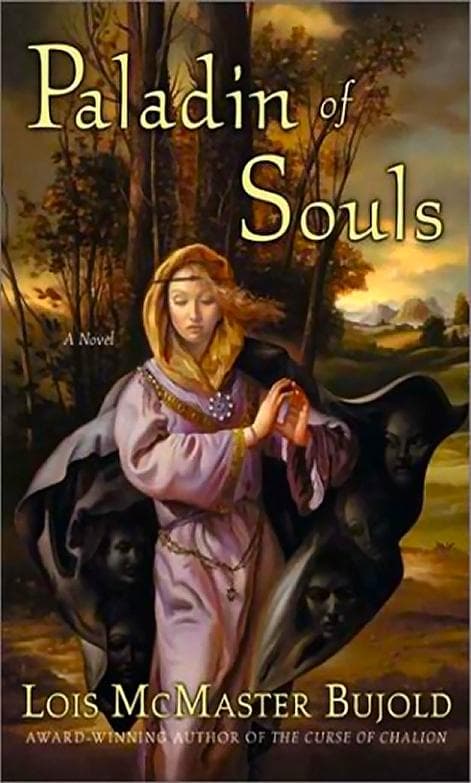
The Woman Who Walked Out of Her Own Diagnosis
Ista dy Chalion is forty, grieving, and has been treated as mad for decades. She is not mad. She was cursed, and the curse was real, and nobody believed her, and she internalized their disbelief so thoroughly that she half-stopped believing herself. When Bujold published this in 2003, that premise read as high fantasy — a noblewoman shaking off the cobwebs of a magical affliction. Read it in 2026 and it lands as something else entirely. It lands as a book about a middle-aged woman whose legitimate suffering was pathologized by every institution meant to protect her, who must physically leave the building to begin recovering. The proliferation of discourse around medical gaslighting, around women's pain being dismissed or reframed as hysteria's polite descendants — anxiety, attention-seeking, hormonal instability — has turned Ista's story from a satisfying character arc into something uncomfortably diagnostic. Bujold didn't predict the specific contours of post-pandemic mental health conversations or the crisis in psychiatric overreach, but she built a protagonist whose central problem is that the people around her have confused being harmed with being broken. That distinction has only sharpened.
What the book could not anticipate is the degree to which pilgrimage — its structuring metaphor — would become both democratized and commodified. Ista's journey on foot, undertaken as spiritual pretext for escape, now exists in a world where wellness retreats, Camino de Santiago Instagram accounts, and "healing journeys" are a consumer category. The novel treats pilgrimage with genuine theological seriousness; the gods of the Quintarian faith are not metaphors but active, constrained agents who need human cooperation to act. This is a world where the divine is real and still largely unhelpful, where being chosen is a burden that looks, from the outside, indistinguishable from madness. Bujold's theology has more in common with Mary Doria Russell's agonized Jesuits in *The Sparrow* than with any comforting devotional framework. Both authors insist that contact with the divine does not clarify — it complicates. But where Russell's Emilio Sandoz is shattered by the encounter, Ista is reassembled. The difference is that Ista is older, angrier, and less willing to be grateful.
The book's blind spots are largely structural rather than ideological. Bujold's Iberian-inflected world is richly imagined but remains a feudal society whose hierarchies are interrogated only through the lens of gender and age, never economics. The Roknari antagonists, coded as the threatening Other from the north, carry the faint residue of Reconquista-era anxieties that feel more visible now than they did twenty-three years ago, when the War on Terror was still young enough that such borrowings passed without much comment. The romantic subplot, too, reveals its era: Ista's late-life love story is treated as remarkable, almost miraculous, in ways that betray a 2003 assumption that desire and agency past forty require special narrative permission. The culture has moved, somewhat, on this point. Not enough, but some.