The Parasite in the Pyramid
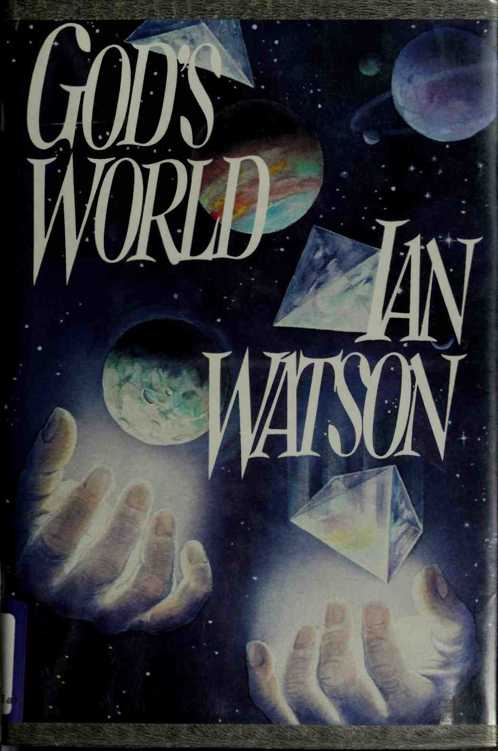
Ian Watson's *God's World* is a book that insists on being taken whole — a sprawling, theologically drunk space opera that refuses to separate the numinous from the mechanical. Published in 2015 but conceived with the sensibilities of Watson's earlier career, it reads like a dispatch from a period when science fiction still believed it could reconcile the mystical and the material within a single narrative architecture. The setup is familiar enough: angels appear at sacred sites, a crystal drive is found in the Gobi, humanity dispatches a crew of rationalists and psychics toward 82 Eridani. What follows is not. Watson constructs a layered ontology — physical space, High Space, Askatharli (an "imagination space" or "Heaven"), and something beyond all three — and then forces his characters to navigate it not with instruments but with love, dreaming, and the willingness to die. The Veil Being, a parasitic quasi-life form from a gas giant that feeds on trapped souls and masquerades as God, is the kind of antagonist that could only emerge from a mind steeped in both Sufism and cybernetics. In 2015, this felt baroque. In 2026, after a decade in which large language models have made the question of "what constitutes a mind, a soul, a self" uncomfortably practical, and in which deepfake prophets have literally appeared at sacred sites via augmented reality, the book's central conceit — that a sufficiently advanced parasite could impersonate the divine and no one would know the difference — lands with a thud that Watson probably didn't intend to be quite so literal.
What the book anticipated, with eerie if imprecise accuracy, is the current crisis of epistemic authority around the sacred. Watson's Easter Day 1997 scenario — simultaneous religious apparitions delivering a composite message, interpreted variously as divine intervention, alien contact, and geopolitical manipulation — maps uncomfortably onto the post-2020 landscape of synthetic media, coordinated disinformation campaigns dressed in spiritual garb, and the weaponization of religious imagery across multiple conflicts. The multinational panel interrogating Dr. Dove about whether the broadcasts represent "a resurgence of mythical thought in a stagnant, overly rational culture" could be a transcript from any number of 2025 policy forums on AI-generated religious content. Watson's insight that rationalism and mysticism are not opposites but complementary failure modes — that a crew needs both to navigate High Space — prefigures the strange détente we've reached between techno-rationalists and the new sincerity movements. Where he got things wrong is instructive: the geopolitics are firmly Cold War–flavored, the Chinese characters are drawn with a heavy hand that betrays the Orientalist residue of his generation, and the idea that nations would cooperate on a crewed interstellar mission rather than racing to weaponize the drive feels almost touchingly naive in the era of orbital debris wars and lunar claim disputes.