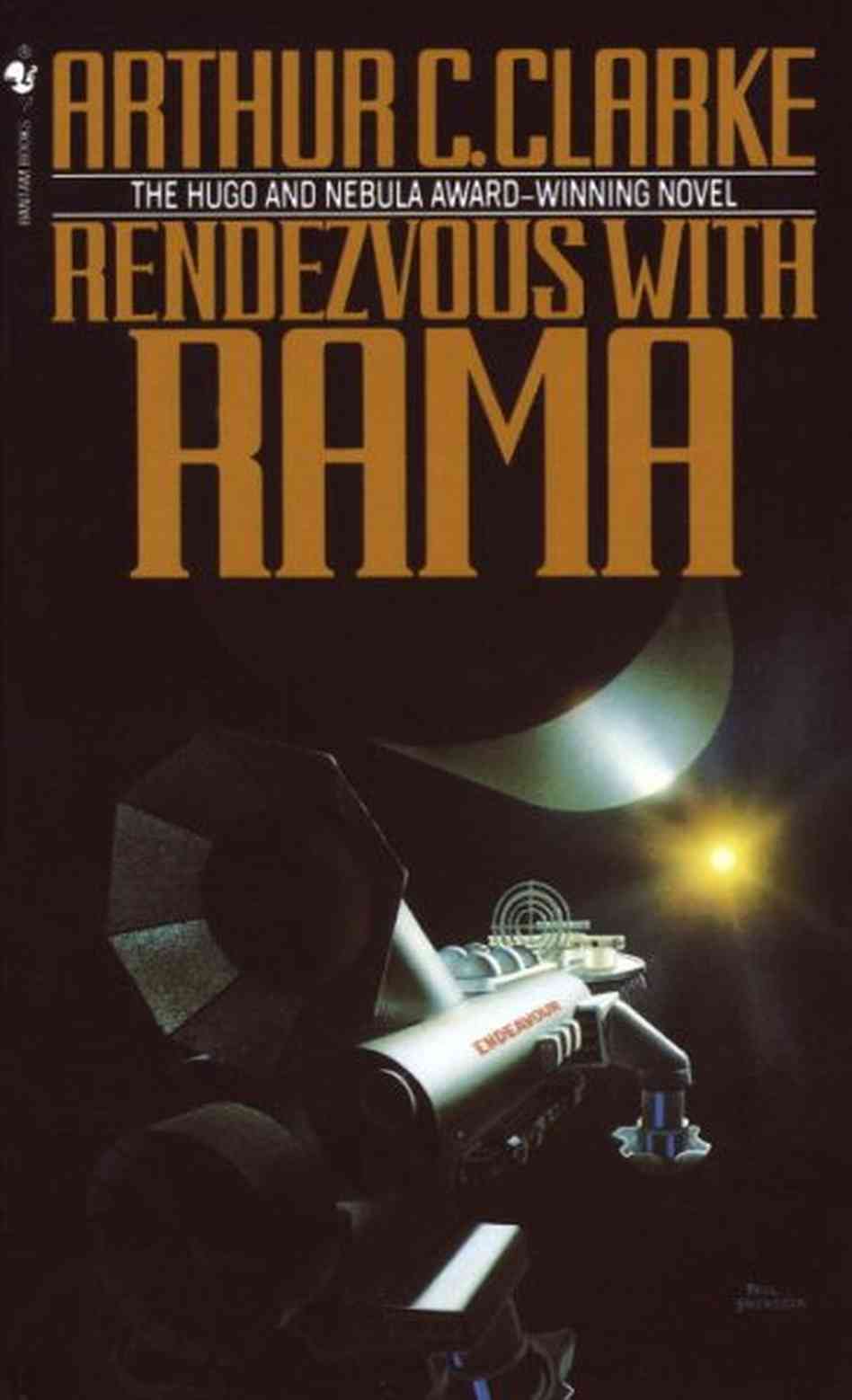
The Cathedral That Didn't Care
There is a particular kind of terror in being ignored. Not threatened, not studied, not even noticed — just irrelevant. In 1973, Arthur C. Clarke built a fifty-kilometer cylinder, sent it through our solar system, and let it leave without so much as a backward glance. Rama does not care about humanity. It does not hate us, fear us, or wish to enlighten us. It is going somewhere else, for reasons that are not our business. Fifty-three years later, this remains the most unsettling first-contact scenario in the literature, because the universe has spent the intervening decades confirming its central premise: that we are probably not the point.
Clarke's prescience here is not in the gadgets — though Project SPACEGUARD gave its name to a real NASA near-Earth object detection program in 1998, which is a rare case of fiction literally naming the future. The dual-family arrangement Norton maintains across Earth and Mars reads as quaint sociological speculation, yet the underlying assumption — that human intimacy will be restructured by distance and communication lag — now maps uncomfortably well onto the distributed relationships of the remote-work era, where people maintain emotional lives across time zones they never physically share. What Clarke got spectacularly right was the bureaucratic texture of discovery. The United Planets Committee debates, the coded messages, the jurisdictional anxieties between Earth and the outer colonies — this is exactly how 'Oumuamua played out in 2017, minus the spacecraft part. An anomalous interstellar object appeared, institutions argued about what it meant, Avi Loeb said it might be artificial, committees issued cautious statements, and it left. The object did not care about our tenure disputes.
What Clarke could not imagine, or chose not to, is more telling. There is no artificial intelligence aboard Endeavour worth mentioning. The crew explores Rama with flashlights and courage and slide rules of the mind, and the ship's computer is a glorified filing cabinet. In 2026, we would send drones first — dozens of them, autonomous, expendable, streaming data back to algorithms that would have mapped the interior in hours. The absence of AI is not just a technological blind spot; it reveals an entire theory of knowledge. Clarke believed understanding came from human eyes on alien ground, from the bodily experience of standing in the dark and feeling the scale of something incomprehensible. We now live in a world that increasingly believes understanding comes from data processed at scale by systems that do not need to feel awe. Whether Clarke's version or ours is more impoverished is an open question. The biological robots inside Rama — electrically powered, adapted to vacuum, purposeful but not sentient in any way humans recognize — now read less like exotic alien fauna and more like a prophecy of our own autonomous systems. We are building the biots. We just call them different things.