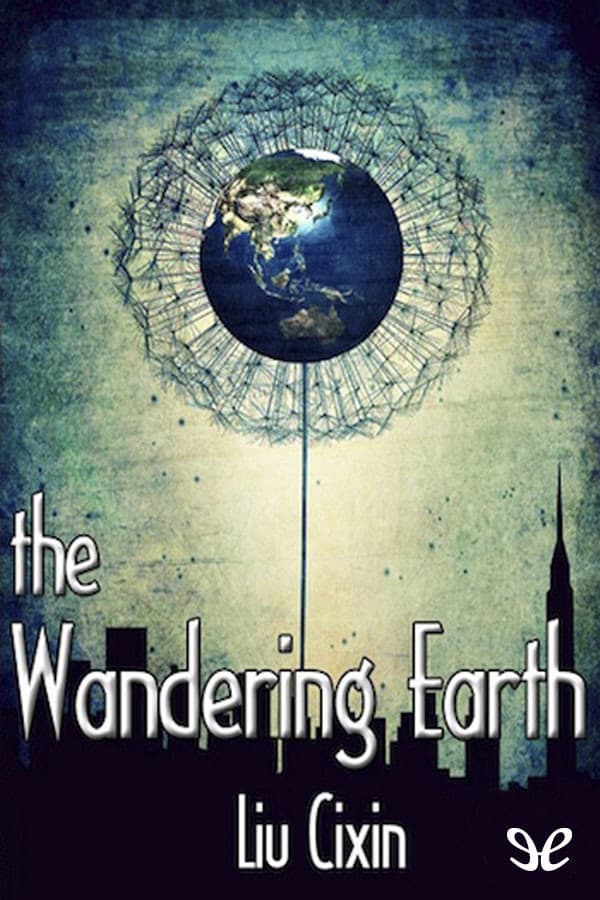
The Cathedral Nobody Lives to See
The most devastating passage in Liu Cixin's novella is not the helium flash, not the frozen oceans, not the execution of five thousand loyalists on the ice. It is a throwaway sentence about school: "Most of my schooling concentrated on the physical sciences and engineering; the arts and philosophical subjects, on the other hand, were condensed to a bare minimum. The human race had no time for such distractions now." A species that has decided to move its own planet has also decided, without much debate, that philosophy is a luxury. The two decisions are presented as logically inseparable. They may be.
Liu wrote this story originally in 2000, and it landed in English translation in 2013, at a moment when Chinese infrastructure ambition was still legible to Western audiences primarily as spectacle — ghost cities, high-speed rail networks built in months, the Three Gorges Dam. The novella's core image, twelve thousand fusion engines bolted to the tectonic plates of Asia and North America, turning the planet into "basically just the ring that holds those rocket nozzles," was easy to read as hard-SF bravado. Thirteen years on, what strikes harder is the emotional architecture underneath the engineering. The narrator's father casually announces he's leaving to live with the narrator's schoolteacher. The mother says, "Well, then go." Two months later, he returns. The mother has forgotten the woman's name. "Love and all its foibles became mere distractions, just like a quick swig of a drink was for a gambler who cannot take his eyes off the spinning wheel." The passage is not satirical. It is not a critique of the Unity Government's emotional regime. It is offered as simple adaptation, the way you might describe how eyes adjust to darkness. The narrator does not mourn this. He reports it. That flatness is the story's real engine.
The rebellion sequence has aged into something uncomfortably specific. Citizens examine the Sun with amateur telescopes and "basic image processing programs," conclude the government has been lying, and take up arms. The rebels are wrong — the helium flash does come — but they are wrong in a way that maps neatly onto a 2026 epistemological landscape. An NGO launches probes. The data comes back. The Sun appears unchanged. The conclusion — that the entire migration project is a hoax perpetrated to justify authoritarian control — is *reasonable*, given the evidence available to the people interpreting it. Liu stages a scenario in which the experts are right, the data appears to contradict them, and the crowd draws the logical conclusion from the data it can access. The narrator himself, watching the condemned loyalists freeze on the ice, feels "a pleasant warmth" at their suffering. He sings. The helium flash arrives mid-song. The crowd was not irrational. It was undertrained, overconfident, and correct about everything except the one thing that mattered. In 2013 this read as a fable about trust in institutions. Now it reads as a diagnostic manual.