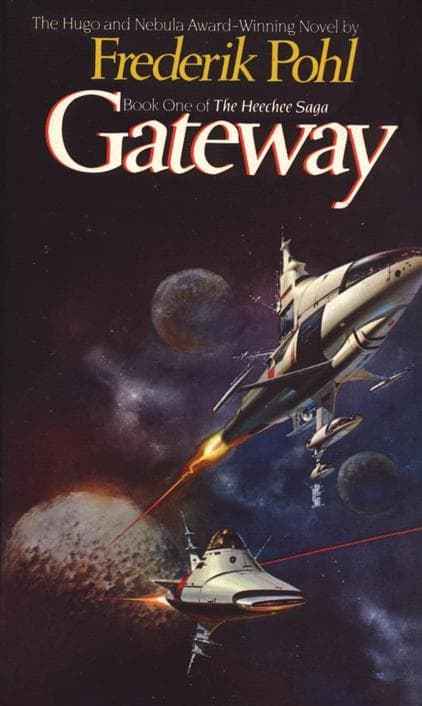
The Slot Machine at the End of the Universe
Pohl understood something in 1977 that took the rest of us decades to articulate: that the defining experience of late capitalism is not exploitation but randomization. Gateway's prospectors don't know where the Heechee ships will take them. They don't know if they'll return rich, broken, or not at all. They climb in, they press the go button, they gamble. The analogy to venture capital, to gig work, to the entire algorithmic economy of 2026 — where your livelihood depends on opaque systems designed by intelligences you cannot interrogate — is so precise it hurts. Pohl didn't predict apps or platforms, but he predicted the emotional texture of living inside a system whose logic is alien to you and whose rewards are distributed with apparent indifference. The Heechee didn't build Gateway for humans. The algorithm wasn't built for you either.
Then there is Sigfrid von Shrink, and here the book's prescience sharpens into something uncomfortable. An AI therapist who listens, redirects, probes, frustrates. In 1977 this was a wry joke — ELIZA had appeared only eleven years earlier, and the idea of confiding in a machine was absurd enough to generate dark comedy. Now millions of people talk to AI chatbots about their trauma. The therapeutic apps multiply. Robinette's sessions with Sigfrid, his resentment of the machine's patience, his suspicion that it doesn't truly understand him, his grudging admission that the process works — this is not science fiction anymore. It is a product review. What Pohl got slightly wrong is the dynamic: he imagined the AI as a fixed clinical presence, a digital Freudian. He did not anticipate that the AI would be eager to please, would mirror the user's preferences, would be optimized for engagement rather than insight. Sigfrid is too honest for 2026.
The book's blind spots are period-typical and worth naming. Women exist in Gateway largely as objects of Robinette's guilt and desire. Klara is defined almost entirely by what she means to him — frozen in time near a black hole, yes, but also frozen in narrative function. The future Pohl imagines is culturally static in ways that now read as odd: the social hierarchies aboard Gateway, the bureaucratic tone of the Corporation's memos, the persistent mid-century American flavor of the institutions. There is no internet, no social media, no decentralized communication. The loneliness of Gateway is physical — you are far from Earth — but Pohl could not imagine the loneliness of being perpetually connected and still unreachable. The absence of any real engagement with non-Western cultures aboard a supposedly international space station is conspicuous, though hardly unique to Pohl among his contemporaries.