The Hounds at the Edge of Immunity
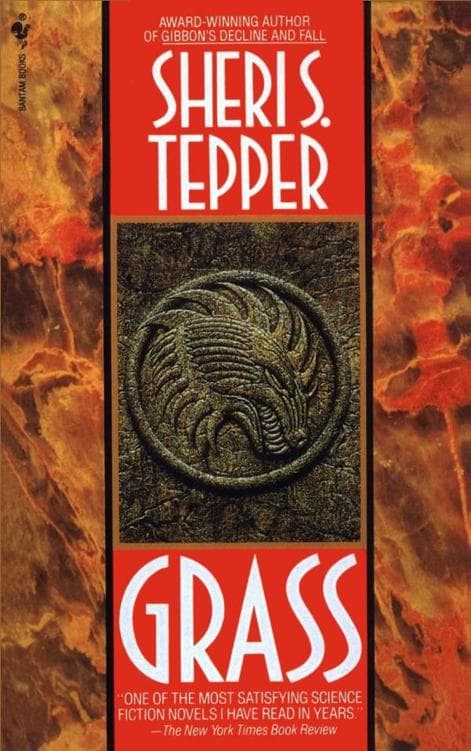
I need to correct something at the threshold. This is not William H. Gass's *Grass* — that would be a short experimental text about language and lawns and the philosophy of seeing. This is Sheri S. Tepper's *Grass*, published in 1989, a novel about a plague-stricken galaxy, aristocratic hunts on an alien prairie planet, and the quiet catastrophe of being a woman inside institutions that demand your silence. The chapter summaries make this unmistakable: the bon Damfels family, the Hippae, the Green Brothers, the Arbai ruins, the foxen. This is Tepper's cathedral, not Gass's garden. The misattribution matters less than what the book itself has become in the intervening decades, so let's proceed with the actual text in hand.
Tepper wrote *Grass* in 1989, which means she was composing it during the early years of the AIDS crisis, and the novel's central conceit — a plague sweeping through human civilization while one world appears mysteriously immune, and powerful institutions suppress knowledge of the disease for political and theological reasons — was not speculative so much as allegorical journalism. Read now, after COVID-19, after monkeypox, after years of watching governments and religious authorities alternately deny, minimize, and weaponize pandemic disease, the novel's portrayal of plague denial feels less like science fiction and more like a operations manual someone left in a drawer. The Green Brothers' doctrine that the plague does not exist, enforced through threat of punishment for heresy, is a structure we watched replicate in real time across social media platforms, state legislatures, and pulpits. Tepper anticipated not just the denial but its institutional mechanics — the way orthodoxy metabolizes inconvenient biological reality into a question of loyalty. What she could not have anticipated is that the suppression would come not from a single hierarchical church but from a distributed, leaderless epistemological collapse. Her villains are too organized. Ours were not.
The novel's treatment of the Hippae — alien creatures who dominate through a kind of neurochemical coercion, compelling humans to participate in rituals that serve the Hippae's reproductive and territorial imperatives while the humans believe themselves to be engaged in noble tradition — reads with a sharper edge now than it could have in 1989. Tepper was writing about patriarchy, obviously, about the way women like Marjorie are conscripted into performances of grace and obedience that serve structures indifferent to their survival. But the Hippae also anticipate something about algorithmic control: the way systems can hijack human agency not through brute force but through the manipulation of desire, ritual, and identity. The bons don't know they are being ridden. They believe they are the riders. This is the defining confusion of the 2020s, and Tepper got the phenomenology of it exactly right, even if her metaphor was biological rather than digital. Marjorie's confession scene — her resentments, her theological doubts, her refusal to accept that suffering is pedagogical — lands now as a precise articulation of the exhaustion felt by anyone who has been told to find meaning in systemic harm.