The Amnesia at the Edge of Empire
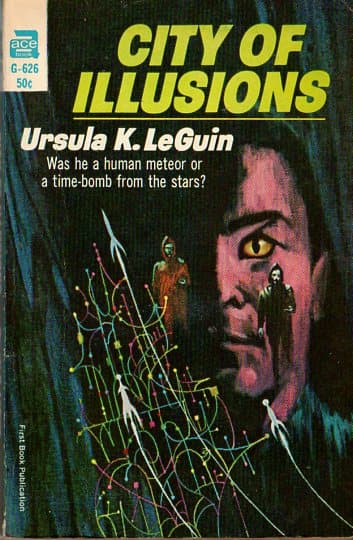
A man walks out of a forest with no memory and eyes that mark him as alien. A civilization that has already collapsed takes him in, feeds him, teaches him language, and then watches him leave to find the people who may have erased him in the first place. This is the architecture of *City of Illusions*, Le Guin's third novel and the last of her early Hainish books before *The Left Hand of Darkness* changed everything. It is a slender, sometimes uneven work, written fast and published in the year of the Summer of Love. It is also, from this distance, a book that understood something about 2026 that most of its contemporaries did not: that the defining political technology of the future would not be the weapon or the engine but the lie. The Shing, Le Guin's antagonists, do not conquer Earth through force. They rule through a systematic capacity to alter what people believe is true — they are masters of mindlying, a telepathic manipulation that makes it impossible to distinguish authentic memory from fabrication. In 1967 this was a metaphor, perhaps, for Cold War propaganda or colonial epistemicide. In 2026, after deepfakes, after algorithmically optimized disinformation, after the practical collapse of shared evidentiary standards in public discourse, it reads less like metaphor and more like field notes. Le Guin did not predict the mechanism — she imagined telepathy, not machine learning — but she grasped the structural consequence: a society in which no one can verify what is true becomes ungovernable in any meaningful sense, and the resulting vacuum is filled not by tyrants but by a kind of ambient, distributed paralysis. The scattered communities of her ruined America, each isolated, each suspicious, each hoarding its own small certainties — this is not a bad description of the epistemic landscape we currently inhabit.
What the book could not imagine is equally telling. Le Guin's future Earth is post-technological in a way that now feels like a period artifact — people have reverted to agrarian communes, and the advanced technology that exists belongs entirely to the occupiers. There is no middle ground, no civilian digital infrastructure, no sense that ordinary people might use sophisticated tools in ordinary ways. This reflects a 1960s assumption, common in New Wave science fiction, that technology was essentially imperial — something done *to* populations, not *by* them. The absence of any communication network among the human communities is the novel's most conspicuous structural gap. Le Guin's scattered peoples cannot coordinate, cannot share intelligence, cannot build collective knowledge, and this is presented as a natural consequence of civilizational collapse. From where we sit, drowning in connectivity and still unable to coordinate, the diagnosis seems half right. The problem was never the absence of networks. It was what networks carry.