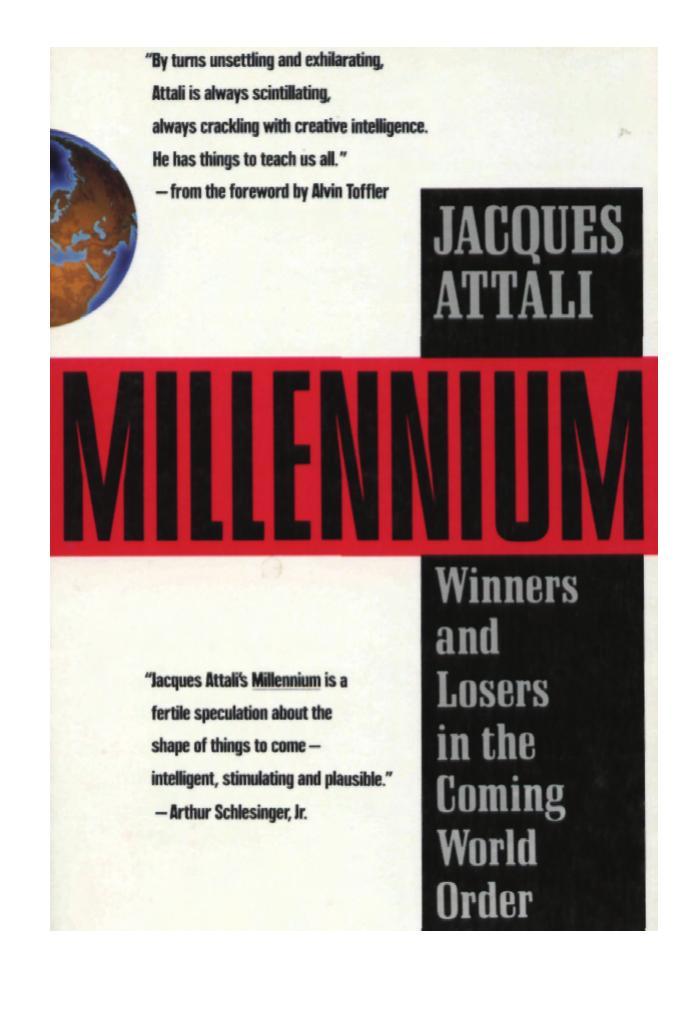
The Prophet Who Packed the Wrong Suitcase
Jacques Attali wrote *Millennium* from the cockpit of François Mitterrand's France, gazing out at a world where the Berlin Wall had just crumbled and the Soviet Union was still twitching. From that vantage he attempted something genuinely audacious: a unified theory of what comes next, not in decades but in centuries. He predicted that economic power would supplant military power as the organizing principle of global order, that a new class of wealthy nomads would roam a borderless world while the poor migrated in desperation, and that the locus of geopolitical gravity would shift away from the United States toward Europe and the Pacific Rim. Thirty-five years later, the ledger is uneven. The nomad thesis is startlingly accurate — digital elites with multiple passports and offshore portfolios living in a post-national economy while climate refugees and economic migrants press against every border. The dominance of economic logic over military logic held true for about two decades, until Russia re-invaded Ukraine and the world remembered that tanks still matter. Attali foresaw globalization's architecture but underestimated how violently the losers of that architecture would kick back. He did not foresee Brexit, MAGA, or the return of explicit nationalism as a mass political force in the very nations he expected to lead the cosmopolitan future.
The blind spots are era-specific and therefore instructive. Attali's Europe-as-superpower thesis was the intellectual consensus of 1991, when the European project seemed to possess an almost teleological momentum. He could not have imagined that by 2026, the EU would be struggling with democratic backsliding in Hungary and Slovakia, strategic dependence on American security guarantees, and a demographic decline that makes his vision of European dynamism read like a period piece. His elevation of Japan as the coming hegemon is the single most dated prediction in the book — written at the peak of Japan's asset bubble, just before the lost decade became the lost three decades. He saw the Pacific Century coming but picked the wrong Pacific power. China appears in *Millennium* as a secondary concern, a vast problem rather than a rival civilization-state with the manufacturing base to challenge American hegemony. This is not a small miss. It is the miss that restructures the entire argument.
What resonates now, almost painfully, is Attali's framework of surveillance and control dressed in the language of consumer convenience. He sketched a world in which personal data would become the currency of power, in which individuals would be monitored not by secret police but by the market itself. He did not use the word "algorithm," but the shape is there — a society in which freedom and observation become indistinguishable. In 1991 this sounded like French intellectual abstraction. In 2026, after Snowden, after Cambridge Analytica, after the normalization of biometric surveillance in democracies and autocracies alike, it reads as a clinical description of the present. His concept of the "rich nomad" — someone whose loyalty is to networks rather than nations, who consumes identity as lifestyle — anticipated the Silicon Valley expatriate, the Dubai crypto class, the Lisbon digital nomad visa holder with a granularity that borders on the prophetic. The "poor nomad," meanwhile, is every migrant drowning in the Mediterranean or walking north through the Darién Gap. Attali saw the topology. He just couldn't see the human cost at sufficient resolution.