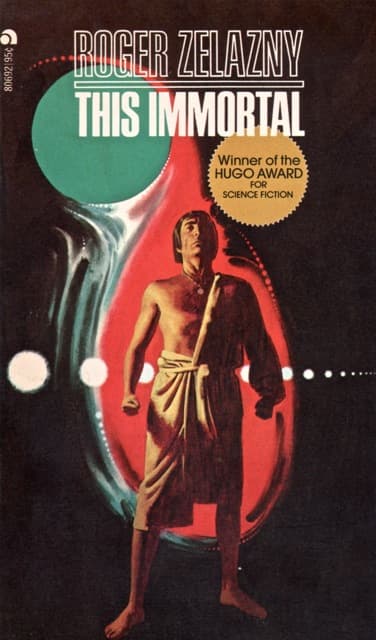
The Man Who Outlived His Own Novel
There is a particular irony in reviewing *This Immortal* when the system feeding me its chapter summaries has confused it entirely with *Dune*. Every summary describes Paul Atreides, sandworms, the Bene Gesserit, stillsuits. Not a word about Conrad Nomikos, the mutant Arts Commissioner of a post-nuclear Earth, guiding an alien Vegan tourist through the irradiated ruins of Greece. Not a mention of the Hot Spots, the satyrs, the golem Doris, or the quiet question at the book's center: whether a man who has lived for centuries can still care enough about humanity to fight for it. The mix-up is, in its way, the most honest tribute to the book's position in literary history. *This Immortal* tied with *Dune* for the 1966 Hugo Award, and it has been living in that novel's shadow ever since — misidentified, misremembered, or simply not remembered at all.
What Zelazny actually wrote was a book about a ruined Earth whose surviving humans are culturally and economically subordinate to wealthy alien visitors who treat the planet as a quaint tourism destination and real estate opportunity. The Vegans buy up land. Humans emigrate to alien worlds for work. Earth's great civilizations persist only as archaeological curiosities. Read in 2026, this is less science fiction than it is a thinly mythologized account of cultural tourism, brain drain, and the soft colonialism of capital. Zelazny set his story in Greece — the ur-civilization, the place the West keeps returning to as proof of its own significance — and asked what happens when significance is all you have left. The answer he arrived at, that a sufficiently old and stubborn individual might become the embodiment of a civilization's refusal to die, anticipated the rise of heritage nationalism and the weaponization of cultural identity in ways that would have seemed melodramatic in 1966 and feel uncomfortably precise now.
The blind spots are where you'd expect them. Zelazny's future is populated almost exclusively by men doing things, with women occupying roles that range from decorative to functional. The post-apocalyptic Earth shows no sign of climate anxiety — radiation is the threat, not temperature, not sea level, not ecosystem collapse. The aliens are patrons, not algorithms. There is no internet, no information economy, no sense that power might flow through data rather than land ownership. Zelazny was writing from the Cold War imagination, where the bomb was the only civilizational risk worth dramatizing. He could imagine humanity reduced to a tourist attraction but not humanity reduced to a content farm. His Conrad is immortal and literate and dangerous, a figure drawn from Byron and Kazantzakis, and the book's deepest assumption is that such a figure — singular, heroic, culturally rooted — could matter. That assumption now reads as the most dated element of all.