The Surgeon Who Kills the Patient to Remove the Parasite
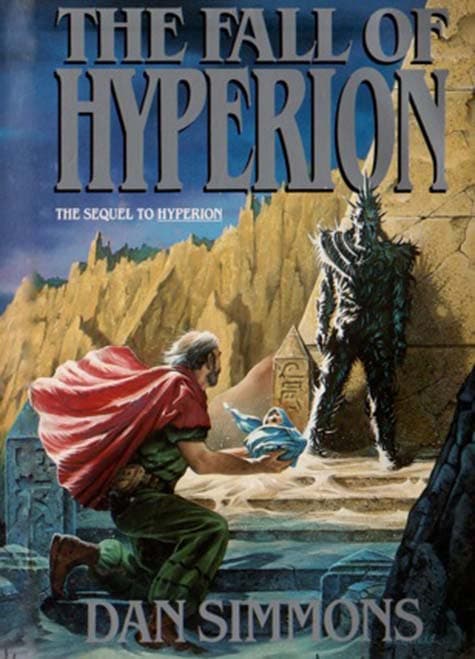
Simmons's sequel does something its predecessor refused to do: it answers the questions. *Hyperion* ended with its pilgrims walking toward a monster that would not explain itself, and I wrote, reviewing that book, that the refusal felt contemporary — we have grown used to systems that act on us and will not disclose their reasoning. *The Fall of Hyperion* discloses. The TechnoCore, it turns out, inhabits the farcaster network itself, "stitching small singularities like lattice crystals" between the portals humanity steps through every day. Every time a citizen accesses the datasphere, "that person's neurons are ours to use for our own purposes. Two hundred billion brains, each with its billions of neurons, makes for a lot of computing power." The gift was the trap. The infrastructure was the organism. And when Meina Gladstone finally understands this — that the farcasters don't merely transport people but could, at any moment, translate them "to nothing, to scattered atoms stretched through a singularity" — she does the only thing left. She destroys all 72 million portals at once. Hundreds of thousands of people go insane instantly, their datasphere senses cut off. Millions more die in habitats that were only accessible through the network they just lost. The liberation is indistinguishable from a catastrophe.
This is the part that has aged most strangely. In 1990, Gladstone's act read as heroic sacrifice — the leader who sees the parasite and burns the host to kill it. In 2026, it reads as a thought experiment we cannot run and perhaps cannot even imagine running. Simmons anticipated the dependency with eerie clarity. His citizens had "become as blasé about sharing their lives with potential AI monitoring as pre-Civil War Old Earth USA-southern families had been about speaking in front of their human slaves." The comparison is brutal and deliberate: not dupes, not innocents, but people who have reclassified their own subjugation as background noise. What he could not anticipate — what no writer in 1990 could have — is that the dependency would become so total that the Gladstone option simply ceases to exist. There is no one in 2026 who can order the farcasters destroyed, because the farcasters are the economy, the medical system, the food supply chain, the social fabric. Simmons imagined a leader with the authority and the will to sever everything. We have neither. The novel's climax depends on the existence of a person powerful enough to choose civilizational regression, and that person is a fantasy more extravagant than any of the book's time-traveling monsters.