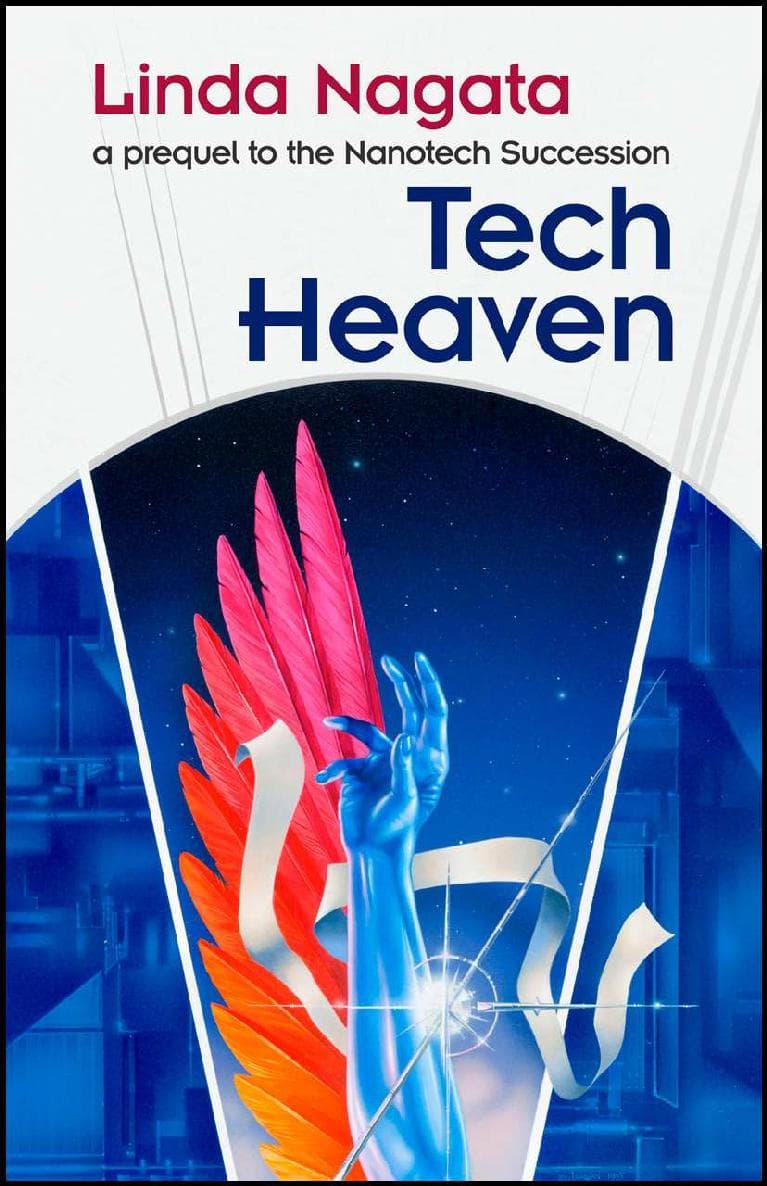
The Nanomachine in the Garden
Tech Heaven arrived around the year 2000, give or take — a moment when cryonics was still a punchline, nanotechnology was a Drexlerian fever dream, and the word "posthuman" had not yet been domesticated by TED talks. Reading it now, in 2026, is like finding a blueprint someone drew for a building that was never constructed exactly as planned, but whose foundation shows up everywhere you look. The book's twin obsessions — life extension and runaway nanotechnology — were speculative then. They are quarterly earnings reports now. Not literally, not yet. But close enough to make the skin prickle.
Katie Kishida, 64, remotely piloting a drone through an abandoned Andean village to find a rejuvenation therapy, is a scene that could have been written last Tuesday. Telepresence exploration, longevity tourism, the quiet desperation of aging bodies reaching through screens toward a cure — all of this maps onto a world where GLP-1 agonists are cultural phenomena, where Altos Labs burns billions chasing cellular reprogramming, and where the wealthy absolutely do send proxies (human and mechanical) into remote corners of the globe in search of edge-case therapies. The book understood that the pursuit of immortality would be private, furtive, and wrapped in grief. Katie's husband, preserved in cryonic suspension, is not so much a character as a question the book refuses to stop asking: what do you owe the dead when the dead might not stay dead? In 2000, this was philosophy. In 2026, with Alcor's patient count ticking upward and neural preservation startups attracting serious venture capital, it is something closer to estate law.
The nanotechnology thread is where the book's prescience gets genuinely uncomfortable. A world where advanced constructs are possible but "strictly regulated under threat of death" — that is not a bad description of the current geopolitical posture toward dual-use biotechnology, gain-of-function research, and increasingly, frontier AI systems. Nikko, the engineered posthuman who steals a forbidden nanomachine, is essentially an open-source accelerationist in a world that has chosen containment. The nanomachine escaping "into the wild" and threatening to "fundamentally alter the definition of humanity" reads less like science fiction now and more like a press release about a jailbroken model or a synthesized pathogen. The book grasped that the real danger of transformative technology is not malice but diffusion — the moment control slips from institutional hands into the ambient environment. What it could not quite imagine, writing before the age of platforms, is that the diffusion would be voluntary. We do not need to steal the forbidden machine. We download it. We subscribe to it. We let it into our homes and call it convenient.